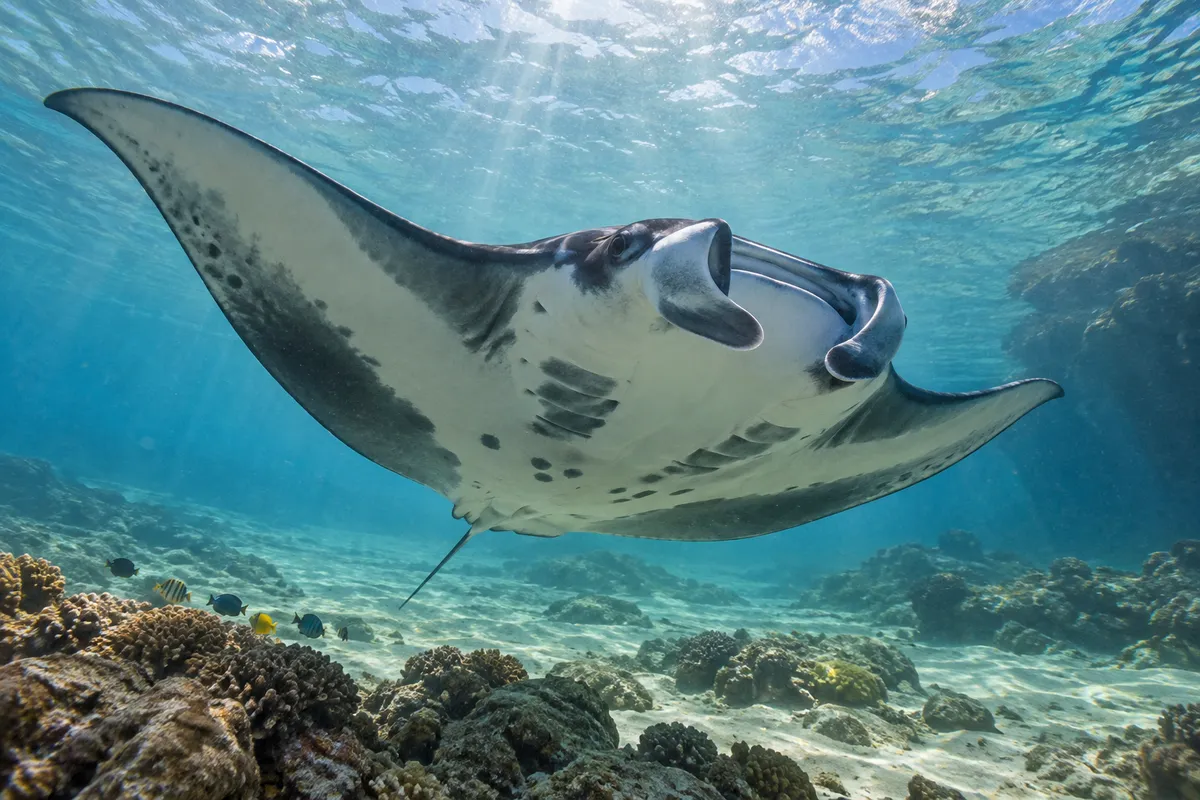
A giant manta ray can reach nine meters (30 feet) long, with a disk up to seven meters (23 feet) across, and weigh as much as 2,000 kg (4,400 pounds). At that size, it has very few natural enemies. So why would a baby manta hide near the coast? Because nobody starts out that big, and the open ocean is a risky place for a small animal.
A new study in Central America, as reported by Phys, shows that young giant manta rays stay in shallow coastal refuges until they grow large enough to survive open-ocean predators. By the end of this article, you'll understand how a manta's life splits into two very different chapters, and why that split matters for protecting them.
Coastlines work as natural nurseries
Think of the shallows as a kind of daycare. According to Phys's report on the study, baby mantas remain in coastal refuges while they grow. They don't head offshore until they're big enough to handle the predators out there.
The logic is simple: size is safety. An adult manta is so large that few animals threaten it. A pup is another story. Staying near the coast buys the young rays time to bulk up before they face open water.
It's a pattern you might recognize from other animals that raise their young in sheltered places. The coast isn't just a pretty backdrop for baby mantas. It's a working part of their survival strategy.
Adults live a very different life
Once mantas grow up, the picture flips. Per the report, adults make long-distance migrations. They leave the sheltered nursery behind and travel across the ocean.
That freedom comes with a new kind of danger. The risk to adults isn't predators, it's people. Phys reports that migrating adults are exposed to fishing and vessel risks once they travel outside protected zones.
So a manta's life has a strange irony built in. The young are threatened mainly by being small, and the giants are threatened mainly by where their travels take them.
Why a single protected area isn't enough
Marine reserves are usually fixed patches of ocean. They can protect a nursery well. But an animal that spends part of its life crossing the ocean spends part of it outside any boundary.
That's the gap conservationists are trying to close. Per the report, the findings arrive as conservation efforts push beyond isolated marine reserves toward connected protections for migratory species. As ocean traffic and industrial fishing expand, manta "highways" across national borders are becoming a conservation priority.
In plain terms, protecting the nursery is necessary but not sufficient. If the babies are safe and the adults aren't, the species still struggles.
The idea of conservation swimways
The approach gaining ground is protecting routes, not just places. Think of it like protecting a whole road trip rather than only the starting town and the destination. Because mantas cross national borders, that kind of protection takes cooperation among multiple countries.
This study adds a useful piece to that puzzle. Knowing that young mantas stay in coastal refuges tells planners where the early chapter of a manta's life happens. Knowing that adults travel far tells them the later chapter needs a wider net.
What this means for you
You don't need to be a marine biologist to take something from this. A few ideas to carry with you:
- Size shapes behavior. Even an animal with almost no predators as an adult has a vulnerable beginning.
- Protection has to match the life cycle. A safe nursery doesn't help much if the migration route is dangerous.
- Borders are invisible to wildlife. Animals like mantas cross national lines, so protecting them means countries working together.
If you're curious about how seafood is caught or how busy shipping lanes are, this is a good example of why those details matter for animals that travel. Industrial fishing and vessel traffic are exactly the pressures that migrating adults meet outside protected zones.
Picture the whole journey
Imagine a small manta pup gliding through warm, shallow water near shore, growing a little each season. Years later, the same animal, now a disk several meters wide, leaves the coast and starts crossing open ocean. Its safety depends on both ends of that trip.
The takeaway: when you hear about protecting ocean wildlife, ask whether the protection follows the animal. For mantas, the answer decides whether a pup that makes it out of the nursery gets to finish the journey.