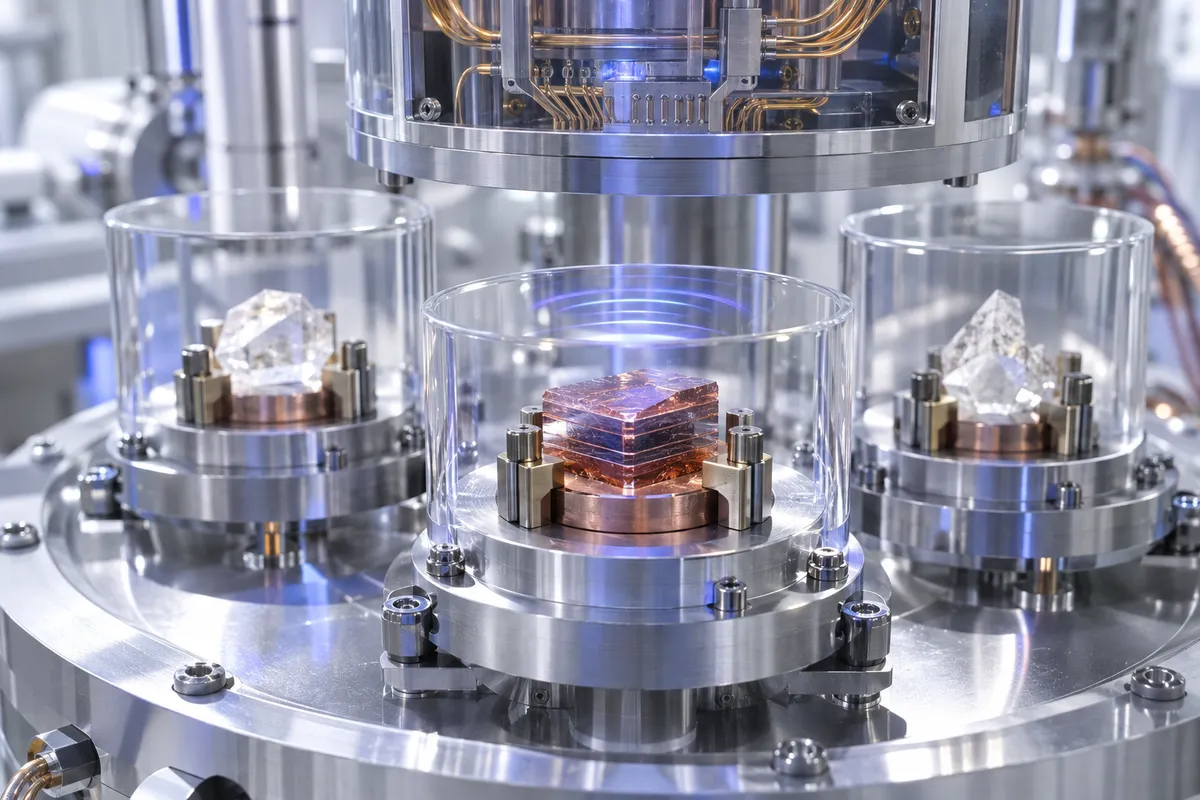
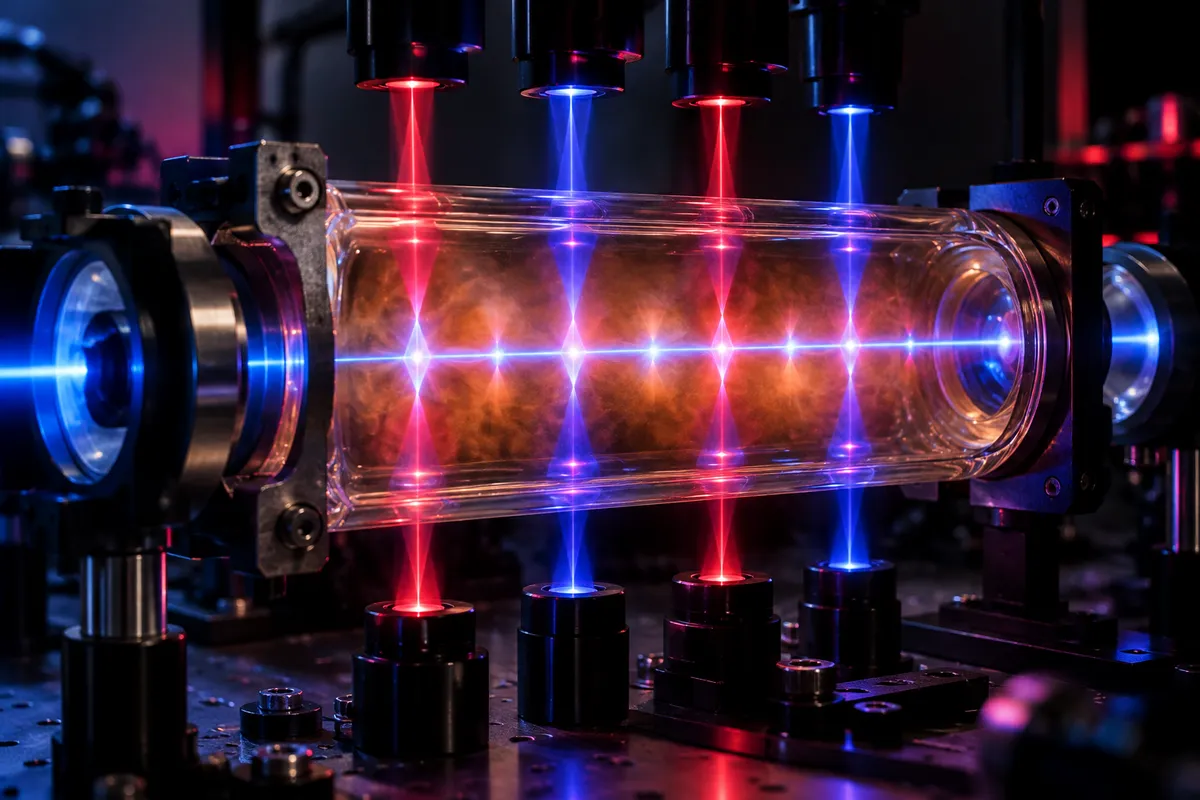
A beam of light normally spreads out as it travels. Shine a flashlight across a room and the spot gets wider. Now imagine a beam that refuses to spread, holding its shape like a tiny particle moving through a crystal. Physicists call that a soliton, and by the end of this article you'll know what makes one, why this one is new, and why a warm cloud of atoms is a surprisingly good place to build it.
Per a report from Phys, scientists from the Quantum Technologies Group at the Institute of Physics Zagreb, working with a colleague from the Physics Department at the Faculty of Science (PMF), have experimentally demonstrated what they describe as the first discrete one-dimensional light solitons in a laser-made photonic lattice inside warm rubidium vapor.
What is a light soliton?
A soliton is a wave that keeps its shape while it travels. Light waves usually fight against themselves. Spreading, called diffraction, pulls a beam wider. A soliton forms when something pushes back with equal strength.
In this case, the push-back is nonlinear self-focusing. In some materials, a strong beam changes the material in a way that squeezes the beam inward. When the outward spreading and the inward squeezing balance, the light stays localized as it moves.
Think of it as a tug of war that ends in a perfect tie, with the beam as the rope that never moves.
What makes this one "discrete"?
The word "discrete" is the new part. Here, the light doesn't travel through smooth, open space. It moves through a lattice, a repeating pattern of spots, a bit like marbles resting in an egg carton.
In a lattice, light hops from one site to the next, and the spreading behaves differently than in open space. That's called discrete diffraction. According to the report, the experiment showed that the atomic medium can balance this discrete diffraction against nonlinear self-focusing, keeping the beam localized as it travels.
So the picture is a stable packet of light sitting across a few sites of a crystal-like pattern and traveling without falling apart.
The twist: the crystal is made of lasers
The lattice here isn't a solid material. It's built from lasers, which create the repeating pattern inside the rubidium vapor. In effect, light writes the structure that then guides other light.
That matters because a laser pattern is not permanent. You can change it. Solid-state lattices, the kind etched into a material, are fixed once they're made. A laser-made lattice can in principle be reshaped by adjusting the lasers.
Why use warm rubidium vapor?
Rubidium vapor is a gas of rubidium atoms, kept warm in this experiment. The report describes it as a tunable atomic medium, and tunability is the selling point. Atoms respond strongly to light of particular colors, so the way the medium behaves can be adjusted by changing the light you use.
That gives researchers a flexible testbed. Instead of building a new solid device for each idea, they can change settings in the same setup and watch how the light responds.
Why it matters beyond one experiment
Per the report, photonics and quantum-technology researchers are moving beyond fixed solid-state lattices toward reconfigurable optical platforms. This experiment suggests warm atomic vapor can serve as one of them. The report points to several areas where such a platform could be useful for testing:
- Nonlinear optics, the study of how intense light changes the materials it passes through.
- Quantum fluids of light, where light behaves somewhat like a flowing liquid.
- PT symmetry, a concept in physics that researchers explore with carefully balanced optical systems.
- Future atomic devices, which the report links to possibilities such as quantum memories, atomic clocks, and chip-scale photonic systems.
These are potential directions, not finished products. This result is a laboratory demonstration of a basic phenomenon, and the step from there to a working device is a long one. What it adds is a flexible place to explore the physics.
The takeaway
The next time you see a beam of light spread across a wall, remember that it doesn't have to. With the right balance of forces, light can hold together like a particle, and in this case it did so in a crystal that only exists because lasers drew it. If a topic in physics sounds abstract, try asking what is pushing, what is pulling, and what happens when they cancel. That one question explains solitons.