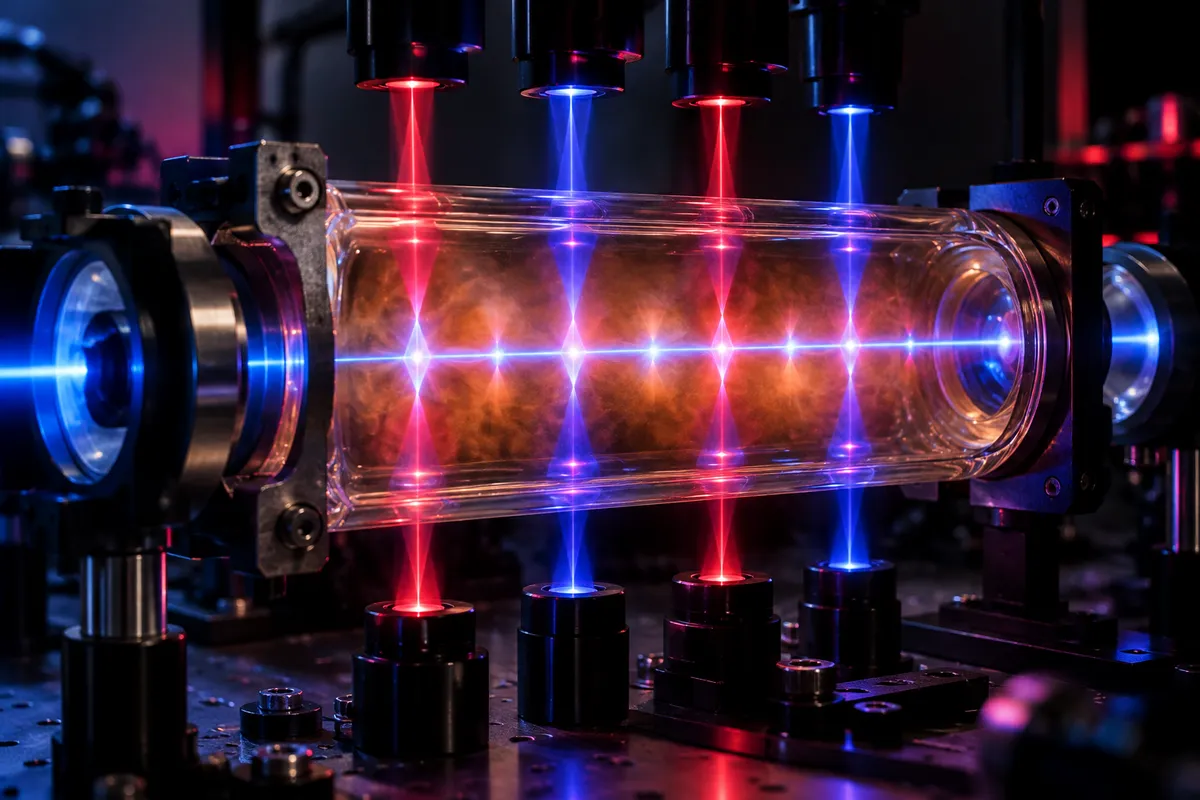

Dark matter makes up roughly 85% of all matter in the universe, and nobody has ever caught a particle of it. A new proposal, reported by Phys, suggests the missing piece might not be a cleverer theory but a better crystal. By the end of this article, you'll know why dark matter is so hard to catch, how certain quantum materials could act like signal amplifiers, and why one of them, titanium diselenide, stands out.
Why dark matter is so hard to detect
We know dark matter is there because of gravity. Its pull shapes galaxies and the structure of the cosmos. But gravity is the only way it has clearly made itself known.
Direct detection means waiting for a dark matter particle to bump into something in a detector and leave a tiny trace of energy. Per the Phys report, traditional methods have struggled with lighter dark matter candidates, because their interactions are extremely weak. A light particle hitting a detector is like a sandgrain landing on a drum: the energy it hands over is so small it can vanish into the noise.
So the problem isn't only finding the right particle. It's building something sensitive enough to notice it.
The amplifier idea: low-energy plasmons
The research looks at three quantum materials: titanium diselenide (TiSe₂), strontium ruthenate (Sr₂RuO₄) and hole-doped diamond. Their shared trick involves plasmons, which are collective waves of electrons sloshing together inside a material.
In these materials, the plasmons have very low energy. That matters because a faint nudge from light dark matter is more likely to stir up a low-energy wave than a high-energy one. The material in effect amplifies a tiny energy signal into something a detector can pick up.
Think of a wine glass that rings when you hit just the right note. A quiet sound can produce a surprisingly noticeable response if the object is tuned to it. These crystals are, loosely speaking, tuned for very small energy kicks.
According to the report, this approach may outperform current detector designs by orders of magnitude. That is a projection for the materials' potential, not a result from a finished experiment.
Why titanium diselenide stands out
Of the three candidates, titanium diselenide shows especially strong potential, per the report. Strontium ruthenate and hole-doped diamond are also in the running, so the proposal gives experimenters a menu of options rather than a single bet.
That variety is useful. Different materials may respond to different kinds of dark matter, and having several candidates means a detector team can pick and combine based on what they want to look for.
Telling a real signal from background noise
Any sensitive detector picks up false alarms. A crucial question is how you'd know a blip was dark matter rather than interference.
The Phys report points to a clue tied to Earth's rotation. As the planet turns, the orientation of the crystal relative to the incoming dark matter changes over the day. If the detector's response depends on direction, a real signal should rise and fall in a daily pattern. Ordinary background noise would not be expected to follow that same rhythm.
It's a bit like checking whether a light is the sun or a lamp: the sun moves across the sky on a predictable schedule. A repeating daily signature would be a strong sign that a detector is seeing something coming from space.
Why particle physics now needs materials science
For decades, the dark matter hunt has been framed as a particle question: what is it, and how heavy is it? This work shifts some of the focus to the detector itself. Choosing the right crystal could matter as much as the theory behind the search.
This is also part of a broader move, as quantum materials go from laboratory curiosities to tools for answering cosmic questions. The same properties that make these materials strange in the lab, such as unusual electron behavior, may be what make them useful for listening to the universe.
What to keep in mind
This is a proposal about what these materials could do, not a detection of dark matter. Building and running real detectors will be the test of whether the promised sensitivity holds up. Still, it's a good reminder that big cosmic mysteries are sometimes cracked from the small end of the scale.
Next time you read a dark matter headline, ask not only what the particle is, but what we're using to catch it. The answer may be a crystal on a lab bench.