
In July 2026, a patrol boat off the coast of Gabon intercepted three trawlers inside the Grand Sud Reserve, one of West and Central Africa's largest marine reserves, where industrial trawling is not supposed to happen. That is the kind of catch that makes headlines. According to a report originally published by Phys, it is also the exception, because much of the illegal fishing in African waters goes unseen.
By the end of this article you'll understand why so many fishing boats can vanish from public maps, how a purpose-built satellite system could find them, and the surprising reason that better technology alone won't solve the problem.
Why boats can disappear at sea
Most people assume ships are tracked the way planes are. Per Phys, the reality is patchier: many vessels avoid public tracking altogether. Self-reported tracking depends on a crew keeping its transmitter on, and a crew that is fishing where it shouldn't has every reason to switch it off.
That's the core weakness. A system that relies on the honesty of the people it is meant to watch will miss the ones who matter most. A boat that goes dark doesn't show up as a problem. It just doesn't show up.
What a satellite can do that a transmitter can't
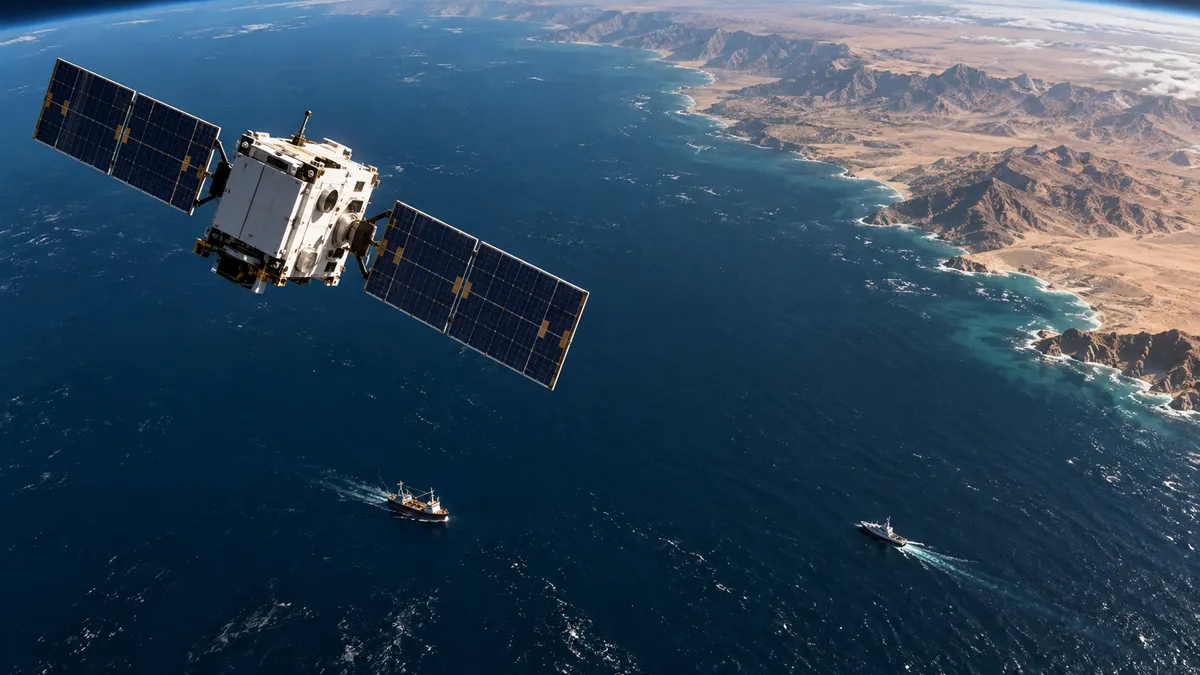
The appeal of satellites is that they don't need the boat's cooperation. According to the Phys report, a purpose-built satellite constellation could detect offenders far more effectively than today's patchwork. The idea is to watch the ocean from above and flag vessels that are present but not reporting.
Think of it as the difference between asking visitors to sign in at the door and installing a camera over the entrance. One relies on trust. The other simply records who walks in.
The numbers: $347 million versus $11 billion
Here is the part that surprises people. Illegal fishing costs African economies an estimated $11 billion to $13 billion every year, per the report. The satellite plan discussed is priced at $347 million.
That comparison is worth pausing on. Even taking the $11 billion low end, the system's price tag is a small fraction of one year's losses. Phys also notes that satellite technology is getting cheaper and more capable, and that commitments at the 2026 Our Ocean Conference show growing political attention to maritime transparency.
So the question is shifting. It used to be "can we see it?" Increasingly it is "will governments act on what they see?"
The real bottleneck: what happens after the alert
A satellite can tell you where a suspicious trawler is. It cannot arrest it. The report argues that the true obstacle is not technology or cost but enforcement, regional cooperation and legal follow-through.
In practice, that means a chain of very old-fashioned steps:
- A patrol boat has to reach the vessel.
- Officers have to board it.
- Prosecutors have to bring a case.
- Courts have to impose fines that actually sting.
If any link breaks, the satellite data is just an expensive picture. The Gabon interception shows the chain working: a patrol, a reserve boundary and three trawlers stopped inside it.
Why neighbors have to work together
Fish don't respect borders, and neither do fishing fleets. A boat chased out of one country's waters can slip into the next. That's why regional cooperation is described as a missing piece. Shared data, shared patrols and consistent penalties make it harder for offenders to simply move down the coast.
It's our analysis, not a claim from the report, but the logic is easy to follow: a satellite network that covers a whole region is most useful when the countries it covers agree to act on the same information.
What this means if you buy seafood
As an eco-conscious shopper, you can't track a trawler yourself, but you can use this story to ask better questions. Where was this fish caught? Is the supplier open about its sources? Transparency at sea and transparency at the fish counter are linked, since the same hidden boats that dodge tracking can end up supplying markets far away. The Phys report focuses on policy rather than shopping advice, so treat this as our takeaway rather than something it states.
The takeaway
Space technology can finally make the ocean's hidden activity visible, and it costs far less than the damage it targets. But seeing is only the first step. When you hear about a high-tech fix for a global problem, ask the follow-up question: who is going to act on it, and what happens next?