A school of fish turns in a flash, thousands of bodies swerving as if they share one mind. It looks like every fish must be tracking the entire group. According to new research reported by Phys, that picture is wrong. By the end of this article, you'll know what these fish seem to be doing instead, and why the answer is simpler and stranger than you'd guess.
The finding: one fish, one neighbor, one split second
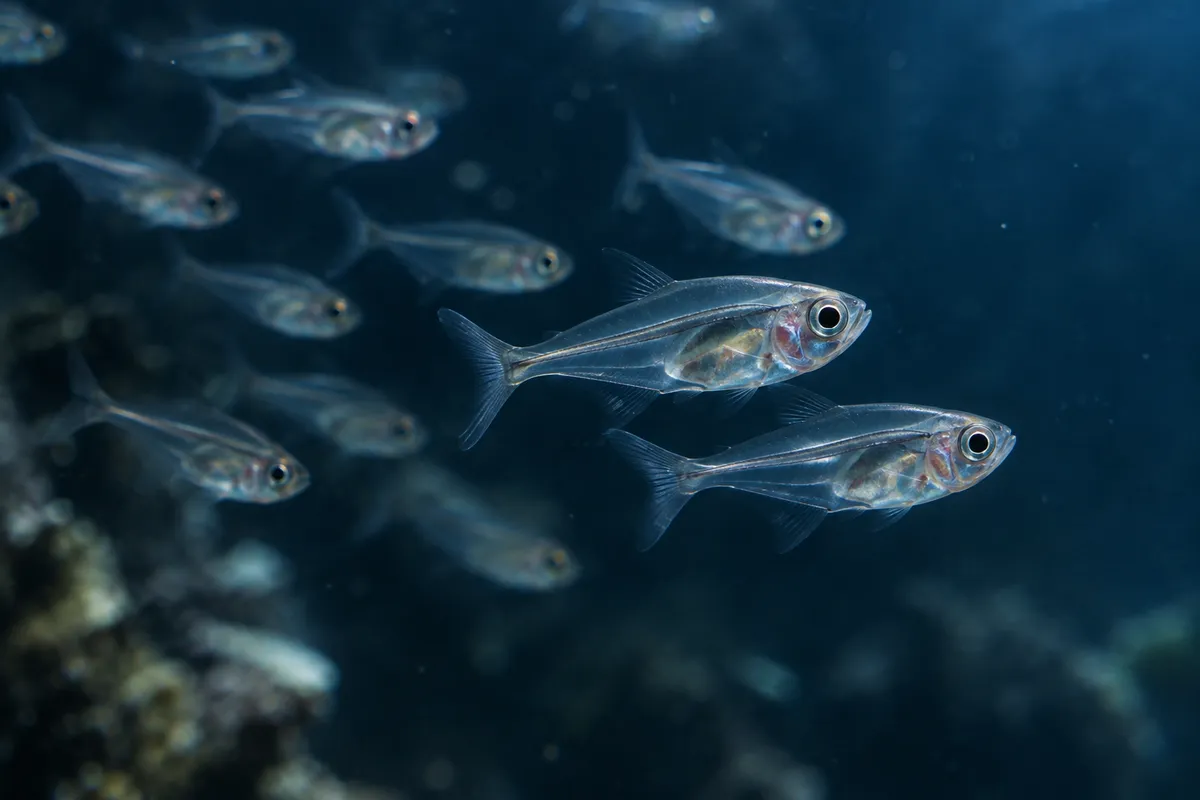
Researchers at UC San Diego studied schools of micro glassfish and found that the groups form through split-second "copying" of one nearby neighbor at a time. The fish aren't averaging the movements of the whole group, which is the long-standing intuition many people have about flocks, swarms and schools.
Think of it as a rule rather than a calculation. A fish glances at one neighbor, matches that neighbor, and then does it again. Stack up enough of these tiny exchanges and the whole school moves in sync.
Why this changes the "hive mind" picture
For centuries, scientists have been fascinated by coordinated movement in flocking birds, swarming insects and schooling fish, per Phys. The natural assumption is that coordination needs a lot of information: where everyone is, where everyone is headed, and some sort of group consensus.
The glassfish result suggests it needs far less. Each animal only has to handle one relationship at a time. That is a much lighter job for a tiny brain, and it still produces the graceful, group-wide patterns we see.
The researchers also link group movement to individual perception and brain processing. In other words, what looks like a crowd-level behavior may be explained by what a single fish sees and how its brain reacts.
How virtual reality tested the idea
Watching fish swim is one thing. Proving why they move the way they do is harder, because you can't easily control what a real neighbor does.
That's where virtual reality came in. According to the report, VR tests confirmed that real fish respond to virtual neighbors in ways predicted by the pairwise-copying model. A virtual neighbor can be programmed to behave exactly as the researchers want, which lets them check whether a real fish reacts the way the model says it should. It did.
This matters because it moves the idea from "a model that fits the data" toward "a rule the fish actually follow." If a computer-generated neighbor can trigger the same copying response, the response is driven by what the fish perceives, not by some hidden group-wide signal.
Why glassfish are a good choice
Glassfish are transparent. That makes it possible to study how tiny brains generate complex group decisions in real time, according to the report. You can't do that easily with an opaque animal.
The practical upside is a bridge between two scales that are usually studied separately: what a single nervous system does, and what an entire group does as a result.
What this might say about people
Phys notes that the study reframes how scientists understand collective behavior, from fish schools to broader social coordination. That's a careful way of putting it, and it's worth keeping the claim modest. Glassfish are not people, and the research was about fish.
Still, it's reasonable to wonder, and this is our own take rather than a finding, whether some of the crowd behavior we see in humans also comes from simple local rules rather than grand awareness of the whole group. When you match the pace of the person walking in front of you on a busy sidewalk, you're doing something that looks a little like what these fish do.
What to remember
Big, coordinated groups don't need big, coordinated minds. The next time you watch a flock, a swarm or a school move as one, look for the small version of the story: each animal reacting to just one neighbor, over and over, fast enough to look like magic.