
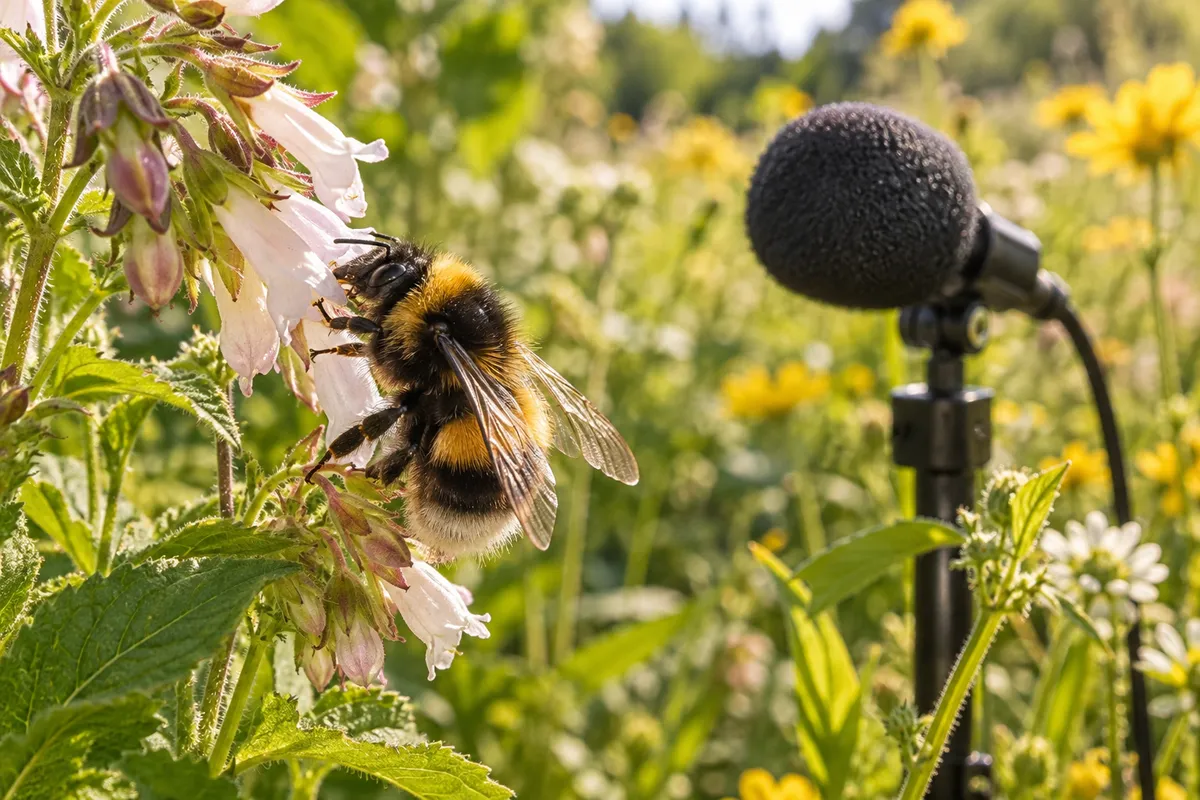
Researchers have trained AI models to listen to field recordings and pick out bee activity, including telling honeybees from bumblebees, according to a report from Phys. By the end of this article, you'll know how that works, why it matters, and what makes it a hopeful step for pollinator conservation.
The problem: counting bees often means killing them
Populations of many pollinators, including bumblebees, have been crashing over the last few decades, per Phys. The reported causes are the widespread use of chemical pesticides, habitat loss, and the acceleration of climate change.
Protecting bees starts with knowing how many there are and where they are. That's where an awkward irony shows up. Traditional pollinator surveys often rely on lethal traps, so the act of counting a struggling population can remove some of its members.
That's the gap this research aims to fill.
The idea: treat a buzz as data
Every flying insect makes sound, and the sound of a bee in flight is distinctive. The researchers recorded audio in the field and trained AI models to recognize two things:
- Whether bee activity is present in a recording
- Whether the bees are honeybees or bumblebees
Think of it like a music-identification app, but for insects. You don't need to catch the performer. You just need a good recording and a model that has learned what each "song" sounds like.
What the researchers found
The main result, as reported by Phys, is that acoustic AI monitoring achieved high precision. In other words, when the models flagged a particular kind of bee activity, they were usually right.
The researchers frame the approach as a complement to traditional pollinator surveys, not a full replacement. That's a sensible claim. Physical sampling can tell scientists things sound alone may not, so the strongest picture likely comes from using both.
Why this approach is useful
It doesn't harm the animals
A microphone doesn't remove a single bee from a declining population. For species already under pressure, that's a meaningful advantage.
It can reach hard-to-sample places
Per Phys, non-lethal AI tools offer a scalable way to track bee activity in hard-to-sample places and conditions. A recorder can be left in a spot that's inconvenient or difficult for a person to visit repeatedly, and the audio can be analyzed afterward.
It scales
Once a model is trained, it can work through recordings far faster than a person could listen to them. That makes it plausible to monitor more locations, which matters when the question is how a whole region's pollinators are doing.
Why bee counts matter beyond bees
Pollinators are part of the machinery of ecosystems and food systems, so tracking their health is a way of tracking the health of the wider environment. Accurate monitoring is essential for conservation: you can't judge whether a pesticide rule, a restored meadow, or a warming climate is helping or hurting without reliable numbers.
This is also part of a broader shift. Animal sounds are increasingly being treated as data that conservationists can analyze, and non-invasive tools like this one fit that trend.
What this doesn't tell us (yet)
The report points to high precision and a complementary role. It doesn't suggest that listening alone can answer every question about pollinators, and the two-way split between honeybees and bumblebees is only a start. Other bee types and other pollinating insects are different challenges. Treat this as a promising tool, not a finished solution.
The takeaway
If you care about pollinators, the encouraging lesson is that protecting them doesn't have to cost any of them their lives. Support efforts that use non-lethal monitoring, and remember that a healthy local bee population is something researchers can now, increasingly, learn by simply listening.