Dark matter makes up roughly 85% of all matter in the universe, and nobody has ever caught a particle of it. By the end of this article, you'll understand why it's so elusive, and how a few unusual crystals might change that.
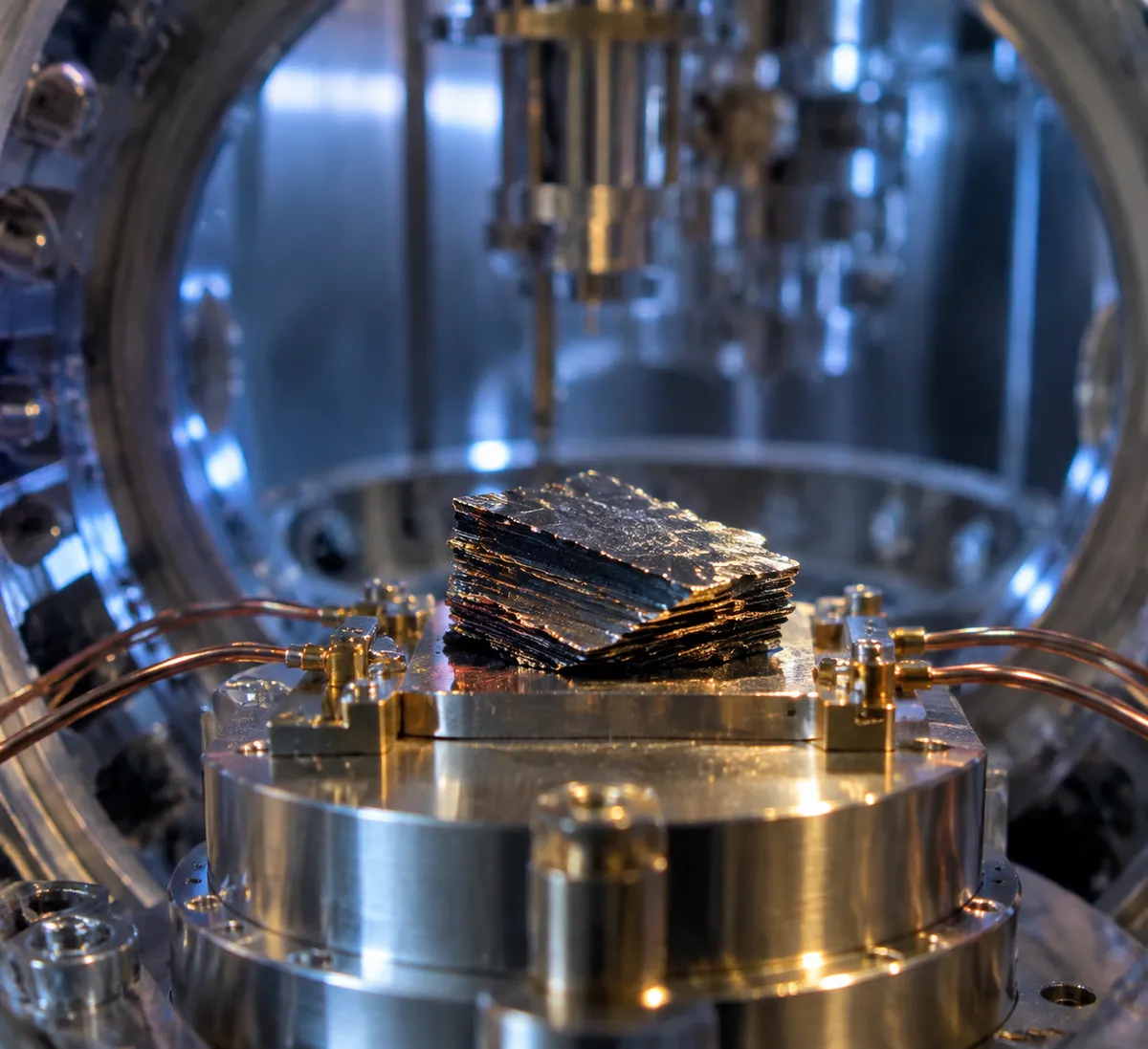
Per a report on Phys, researchers are exploring three quantum materials as ultra-sensitive detectors for light dark matter: titanium diselenide (TiSe₂), strontium ruthenate (Sr₂RuO₄) and hole-doped diamond. The reported main finding is that these materials may outperform current detector designs by orders of magnitude, with titanium diselenide showing especially strong potential.
The twist is that the breakthrough isn't a new theory about dark matter. It's a better choice of material.
Why dark matter is so hard to catch
We know dark matter is there because of its gravity. Its pull shapes galaxies and the structure of the universe. But gravity is the only way it has clearly announced itself.
Detecting it directly means spotting the rare moment when a dark matter particle bumps into something ordinary inside a detector. For lighter dark matter candidates, that bump is extremely gentle. It deposits a tiny amount of energy, so small that traditional detection methods have struggled to pick it up, according to Phys.
Think of trying to hear a single grain of sand land on a table in a noisy room. The problem isn't that the grain doesn't exist. It's that your ears aren't sensitive enough.
The trick: amplify the whisper
This is where quantum materials come in. The idea described in the report is to use materials that can amplify tiny energy signals through low-energy plasmons.
A plasmon is a collective ripple of electrons moving together inside a material, a bit like a wave passing through a crowd doing the stadium wave. In ordinary detector materials, a faint nudge from a light dark matter particle may not stir up much. In these quantum materials, low-energy plasmons can respond to a very small disturbance, boosting a signal that would otherwise be lost.
That's what the researchers mean by a more sensitive detector: not a bigger one, but one whose material is better at turning a whisper into something measurable.
Meet the three candidates
The three materials named in the report are:
- Titanium diselenide (TiSe₂): the standout, showing especially strong potential as a next-generation dark matter detector.
- Strontium ruthenate (Sr₂RuO₄): a quantum material that also makes the list as a possible detector.
- Hole-doped diamond: a diamond modified so that it has the right electronic behavior for the job.
The reported result is that these may beat current detector designs by orders of magnitude. That phrase means not 20% better, but potentially tens or hundreds of times more sensitive, or more. This is a prediction about potential, not a finished detector sitting in a lab, so treat it as a promising direction rather than a done deal.
Why titanium diselenide gets the spotlight
Of the three, titanium diselenide is the one Phys highlights as having particularly strong potential. The summary doesn't spell out every reason, so we won't guess. What it does tell us is that when the researchers compared the materials, TiSe₂ came out looking especially promising for amplifying faint signals from light dark matter.
If you remember one name from this story, make it that one.
Earth's rotation as a built-in fact check
One of the hardest parts of any detection is knowing whether a signal is real or just noise. The report points to a clever safeguard: Earth's rotation.
The idea is that a real dark matter signal could follow a daily pattern as the planet turns, changing as the detector's orientation shifts relative to the dark matter around us. Random background noise wouldn't be expected to repeat on that schedule. So a signal that rises and falls with the rotating Earth would be much harder to dismiss as a glitch.
I'd put it this way, as my own interpretation: it's like checking whether a rumor holds up by seeing if the same story comes back from different directions at the same time each day.
Why particle physics now needs materials science
For decades, the dark matter hunt has been framed as a question about particles: what are they, and how heavy are they? This work shifts some of the weight to a different question: what is the detector made of?
Phys frames it as a new path where detector design may matter as much as particle theory. Crystals once seen as lab curiosities, with strange electronic behavior studied for its own sake, are becoming tools for answering cosmic questions. A diamond with deliberately added electronic properties could end up helping probe the structure of the universe.
What this does and doesn't mean
No dark matter has been detected here. The finding is that certain materials could, in principle, make detectors far more sensitive to the lighter dark matter candidates that current methods struggle with. Turning that into a working experiment is the next challenge, and the summary doesn't say when that might happen.
But it changes what's worth building. If a crystal can amplify a signal by orders of magnitude, the search for dark matter doesn't have to wait for a completely new idea. It may only need a better material.
The next time you hear that dark matter is invisible and undetectable, add one word: so far. Then watch what happens in the labs growing crystals.