A paper posted to arXiv, titled "AI and the Enclosure of the Scientific Commons," makes an argument that is easy to grasp in about two minutes. Scientific knowledge is a shared resource, and AI could turn that shared resource into private wealth, much as land once was. It drew attention on Hacker News, where the post collected 126 points and 74 comments. By the end of this article, you'll understand the analogy and the questions it raises about who gets to profit from public research.
This piece relies on the paper's framing as summarized from its arXiv listing. I haven't gone beyond what that summary supports, so treat what follows as an explanation of the paper's argument, not a verdict on it.
What is an "information commons"?
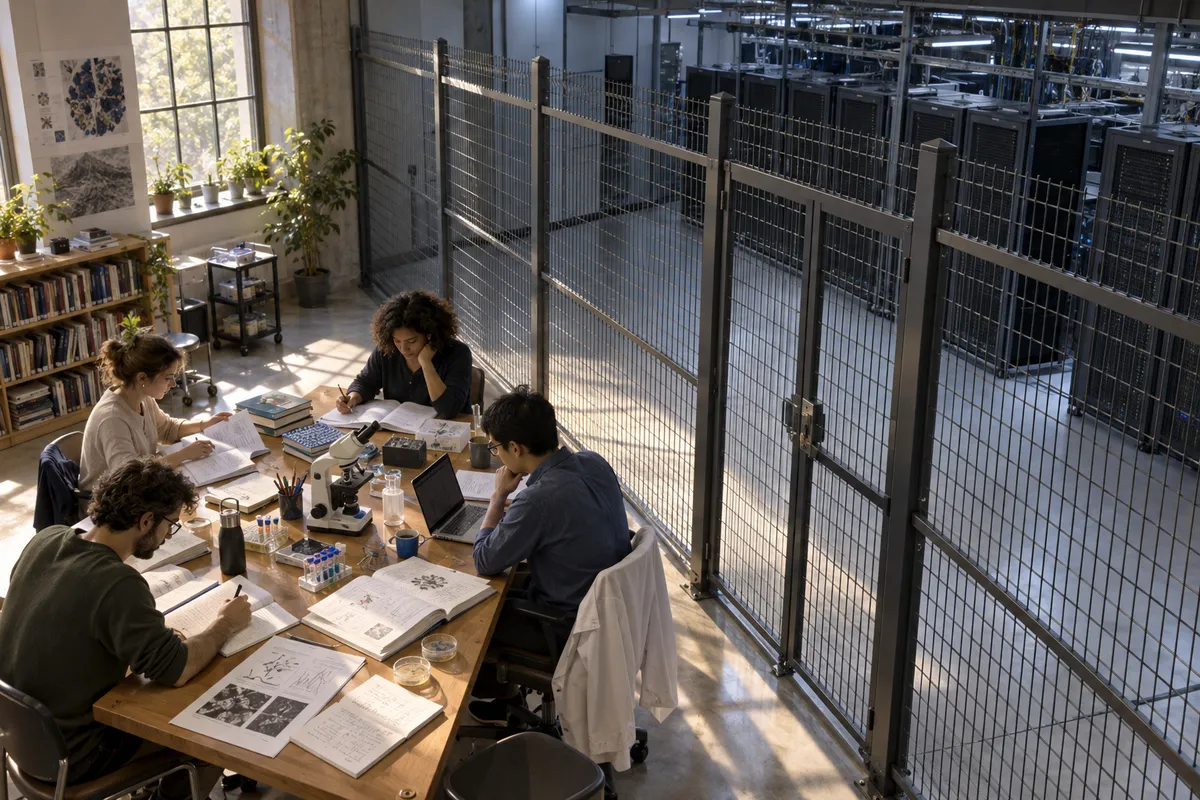
The paper treats scientific literature as an "information commons." Think of a village green that everyone can use. Anyone can graze animals there, and the whole community benefits from it.
Scientific papers work similarly. Researchers publish findings, other researchers build on them, and the pool of knowledge grows. Nobody has to ask permission to read a paper and learn from it, at least in an open system, and that openness is a big part of why science moves forward.
What was enclosure, and why does the comparison fit?
The historical enclosure movement is the story of common land being fenced off and turned into private property. Land that many people had used together ended up controlled by a few. The paper connects that history to what it sees happening with knowledge today.
The parallel it draws is about three things: extraction, privatization, and pollution. In the enclosure story, the resource was land. In the AI version, the resource is the accumulated work of the scientific community.
Extraction
AI companies train on public research at scale, per the paper's argument. The commons is the raw material.
Privatization
Once that knowledge is absorbed, summarized, and monetized, the benefit flows to whoever owns the AI product. The paper's concern is that shared scholarly knowledge becomes private wealth.
Pollution
The third piece is less obvious. The paper warns that knowledge systems can be polluted by what it calls "slop spam," a flood of low-quality AI-generated content. If real research and machine-made filler get mixed together, the commons gets harder to trust and harder to use.
Why "open" doesn't mean "free for any use"
A natural reaction is: if the papers are open, what's the problem? This is one of the angles the paper's framing raises. Open access was meant to let people read and share research. It was not necessarily designed with industrial-scale harvesting in mind, where a company takes that openness and builds a paid product on top of it.
The village green offers a useful comparison. Letting neighbors graze sheep is different from letting one operator bring in a thousand and sell the wool. The same openness can mean very different things depending on who is using it and how.
It's not a copyright story
Much of the public debate about AI and creative work centers on copyright: who owns the text, and who gets paid. The paper's framework points somewhere broader. The concern is structural. It's about what happens to a shared system when private actors capture its value.
That difference matters. A copyright dispute can be settled one case at a time. A commons can be hollowed out gradually, without any single dramatic moment.
Tragedy of the commons or theft of the commons?
You may have heard of the "tragedy of the commons," the idea that shared resources get overused and ruined because nobody owns them. One angle the paper's framing invites is a contrast with that idea. In a tragedy, everyone drains the resource a little. In a theft, someone takes it on purpose, and the benefits go to them.
The distinction changes what you do about it. If the problem is overuse, you manage the resource more carefully. If the problem is capture, you need rules about who gets to take and who gets to profit.
Why the stakes are rising
As AI companies train on, summarize, and monetize public research, the future of open science is turning into a live political and economic fight. Nobody has settled what the rules should be, which is exactly why the framing is useful. It gives people a way to ask the question before the answer is decided by default.
What might need protecting
The paper's framing points to several groups with a stake: scientists who produce the work, publishers who distribute it, and policymakers who set the rules. I can't tell you from the available summary which specific protections the authors propose, so I won't guess. But the questions they raise are easy to carry with you:
- Who gets to benefit when public research becomes the foundation of a commercial product?
- How do you keep real findings distinguishable from AI-generated filler?
- What would it take to keep knowledge open to readers without leaving it open to wholesale capture?
The takeaway
Next time you see an AI tool summarize a scientific finding, ask where that knowledge came from and who built it. Research is a shared inheritance, and the people who care about it can start by asking who gets the harvest.