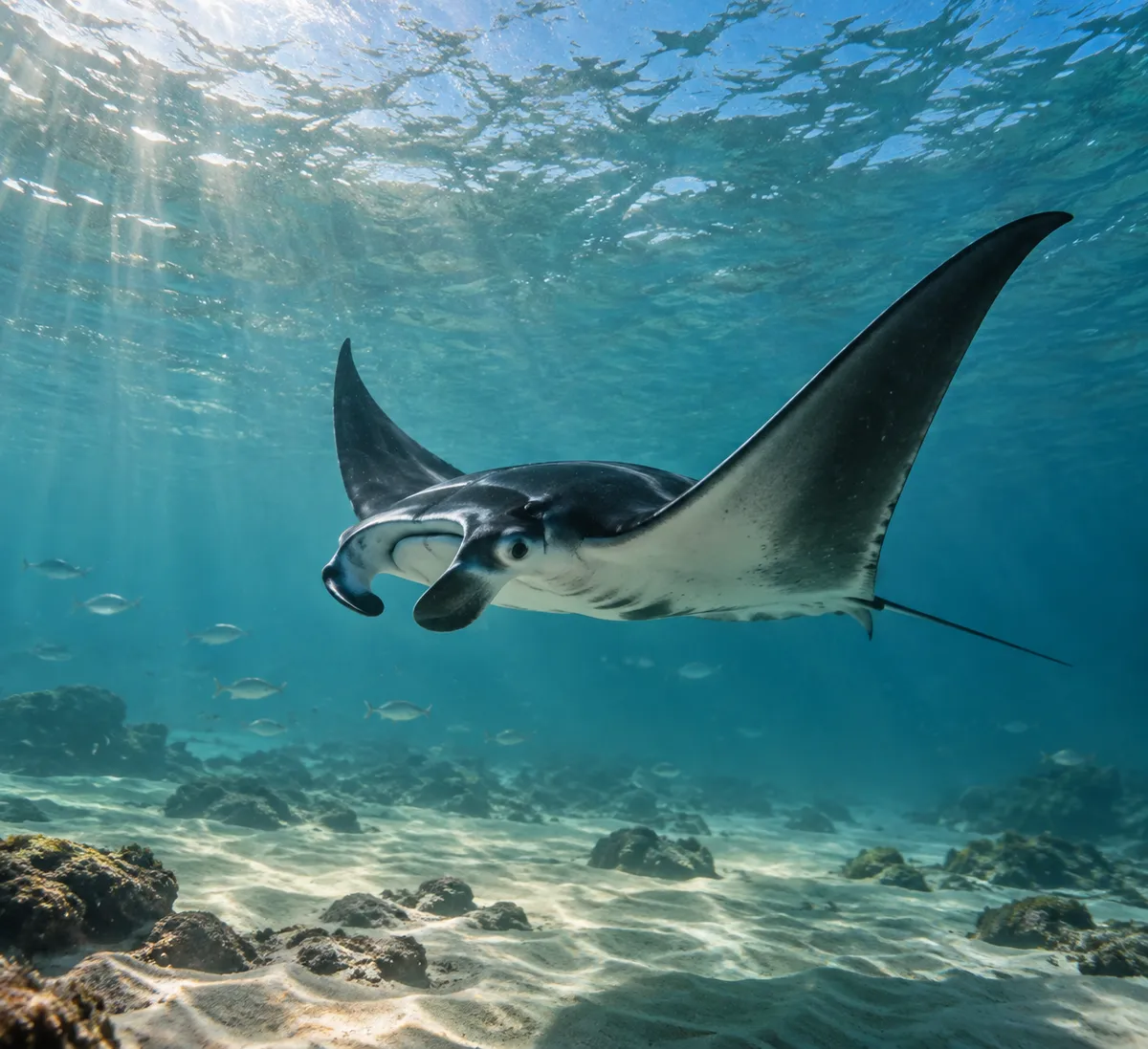
A giant manta ray can grow up to 30 feet long and weigh as much as 4,409 pounds. But every one of them starts out small, and small is a dangerous size in the open ocean. A new study in the journal Frontiers in Fish Science, covered by Popular Science, shows how young giant manta rays (Mobula birostris) in Central America solve that problem: they stay close to shore, where food is plentiful and their predators mostly aren't.
By the end of this article, you'll know where baby mantas hide, how researchers figured it out, and why the answer changes how we protect these animals.
Why a small manta ray stays near the coast
Baby mantas, called pups, don't have the size that protects adults. Per the study, the open ocean is hunting ground for orcas (Orcinus orca) and numerous sharks, and a young ray has little defense against them.
So the pups stick to shallow, nearshore water. According to the researchers, these coastal refuges do not overlap with predators' hunting grounds. They also offer:
- Plenty of food
- Places to hide
- Cleaning services from reefs
Think of it as a nursery with a built-in pantry and a spa. Jeffry Madrigal-Mesén, a study co-author and project leader of Mantas Costa Rica, put the contrast this way: "Mature adults can rely on their massive body size and their ability to dive deep to evade threats. But juveniles don't have that luxury."
In the study, "young" meant mantas with a body of about 10 feet or less.
How researchers pieced it together
Between 2018 and 2025, the team tracked and identified mantas at five locations. No single tool could show the whole picture, so they combined three:
- Acoustic telemetry uses underwater sound pulses to monitor fish movements. It let the team track 59 individual rays.
- Satellite telemetry uses transmitters to follow movement from a distance. It covered large-scale movements of 12 individuals.
- Photo identification helped recognize individual rays.
The result was a dataset of more than 12,000 detections. Madrigal-Mesén said, "If we hadn't used all three technologies together, we simply wouldn't have been able to piece this puzzle together."
The juveniles are remarkably loyal
The surprise isn't just that pups stay shallow. It's how strictly they do it. The tracked juveniles remained within shallow nearshore waters, and the team saw the same individuals more than once a year. Madrigal-Mesén said some were recently sighted again at the exact same tagging location.
The team followed one immature manta, nicknamed Puntitos, as part of this work.
What changes when they grow up
Adults live differently. Of the mature mantas in the study, nine made expansive migrations along the continental shelf break. Madrigal-Mesén said, "Giant manta rays in Central America undergo a dramatic shift in space use as they mature."
But adults don't abandon the coast entirely. One male, nicknamed Mickey Mouse for a spot pattern on his belly, suggests that loyalty to a site can continue into adulthood. He was unusually approachable for a manta, which let the team tag him several times over the years. In 2020 he logged 462 acoustic detections at a coastal hub called El Secreto. In 2023 he returned to the same shelf and stayed 38 days.
Why return? Madrigal-Mesén explained that nearshore cleaning stations do more than keep rays tidy: "they act as primary social hubs where courtship and reproductive interactions take place." Returning to a predictable coastal spot lets adults handle social and cleaning needs before setting off on large regional migrations.
The risk: protection stops at the coast
This life-stage split creates a conservation puzzle. Per the researchers, coastal areas are often legally protected marine reserves. The open ocean is another story. Once adults leave, they lose that legal protection and face industrial fisheries and vessel strikes.
The team concludes that marine protected areas alone aren't enough for a species this mobile as it moves across Central America.
What are "conservation swimways"?
Their proposed fix is multi-national "conservation swimways." The idea is to link the juvenile coastal refuges within individual countries with the migratory corridors adults use. In theory, that keeps endangered rays safer across their whole lives, not just the early years. The study frames it as a possibility that could help, not a proven solution.
What this means for how you think about ocean animals
It's easy to picture a species as living in one place. This research is a reminder that an animal's needs can change completely as it grows. A habitat that is perfect for a 10-foot pup may be irrelevant to a multi-ton adult, and the adult's route may pass through waters with weaker rules.
Madrigal-Mesén said the team hopes the study "sparks fresh enthusiasm" and draws future collaborators to new research projects aimed at conservation of the species.
The takeaway to carry with you: when you hear that an ocean species is "protected," ask where, and at what stage of life. For manta rays, the answer to that question may decide whether a safe childhood leads to a safe adulthood.