By the end of this article, you'll know why the early universe was opaque, what it means for galaxies to carve out a "bubble," and why a tight cluster of 18 faint galaxies has astronomers excited.
The new find: 18 galaxies in one crowded neighborhood
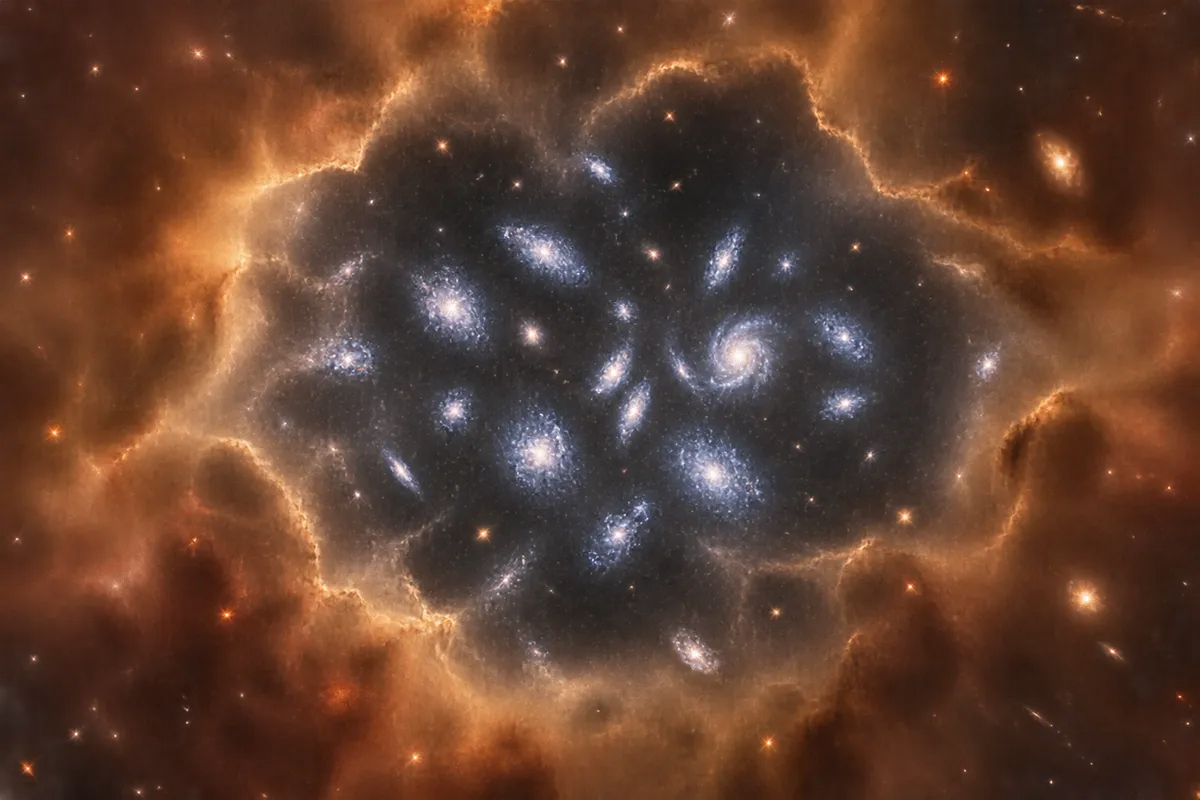
Per a report from Phys, data from the James Webb Space Telescope's JADES survey reveals a dense group of 18 early galaxies, seen about 500 million years after the Big Bang. The group may be creating a large bubble of ionized hydrogen around itself.
If that holds up, it would be the earliest known ionized bubble produced by a galaxy overdensity (a region where galaxies are packed more tightly than average). It could also offer some of the earliest evidence for how cosmic reionization began.
That's a lot of jargon packed into one discovery. Let's unpack it.
Why the early universe was like a fog
Picture driving through thick fog at night. Your headlights shine, but the light scatters and you can't see far. The early universe was a bit like that, except the fog was neutral hydrogen gas filling space.
Neutral hydrogen absorbs and scatters certain kinds of light, so the universe was not transparent the way it is today. Reionization is the transition that changed this. Energetic light from the first galaxies stripped electrons from hydrogen atoms, turning the gas "ionized." Ionized gas lets light pass through far more easily, and the universe became transparent to light.
That's the big picture: reionization is how the cosmos went from foggy to clear.
What an ionized bubble actually is
The change didn't necessarily happen everywhere at once. The idea behind a bubble is simple: a galaxy, or a group of them, floods its surroundings with energetic light. That light clears a pocket of gas around it, like a patch of fog burning off around a streetlamp.
When many galaxies sit close together, their combined output can clear a larger region than any single galaxy could. That's why this group of 18 is interesting. Per the report, the dense cluster may be doing exactly that, carving out a big bubble in the early universe.
Why this particular group stands out
Two things make the finding notable:
- Timing. At roughly 500 million years after the Big Bang, the universe was very young. Seeing a possible bubble that early would make it the earliest known one linked to a galaxy overdensity.
- Mechanism. It points to a possible way reionization got started: dense galaxy neighborhoods clearing the fog first, with the effect spreading from there.
The word "possible" matters. The reported finding says the galaxies may be creating the bubble, and the result would need confirmation. This is an early piece of evidence, not a closed case.
Why JWST keeps surprising astronomers
JWST has repeatedly forced scientists to revisit the timeline of early galaxy formation. This discovery fits that pattern, and it adds a candidate mechanism for one of cosmology's biggest transitions. The telescope can see faint, distant galaxies, and surveys like JADES let astronomers map how those galaxies are distributed, not just count them.
That distribution is the key here. A single galaxy is one small lamp. A crowded group is a whole lit-up street, and it may have shaped its surroundings in a way a lone galaxy could not.
What to take away
The universe didn't become clear on its own. Light from the first galaxies likely did the work, and the clearing may have started in crowded galactic neighborhoods. This group of 18 could be one of the earliest glimpses of that process in action.
Next time you look at a deep-space image full of tiny, faint smudges, remember what they might be: not just distant objects, but the very things that helped make distant objects visible at all.