
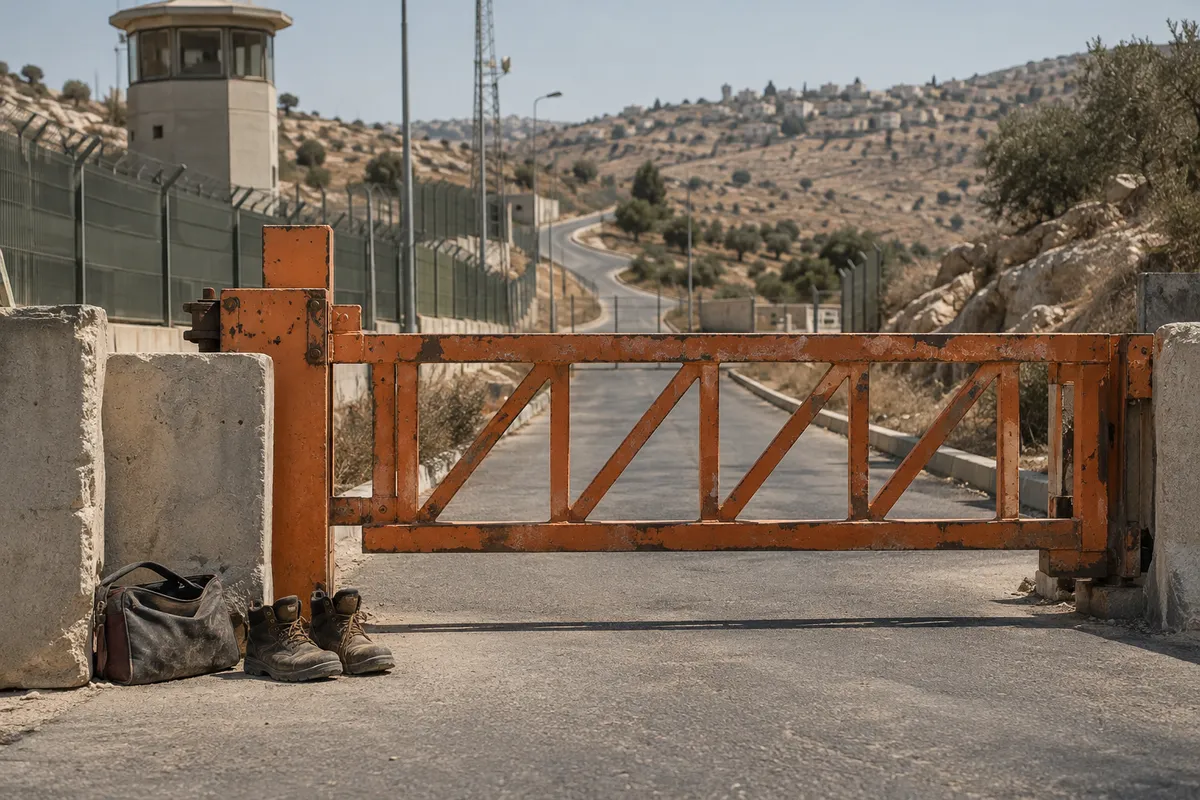
Israel will close all West Bank land crossings on election day and bar Palestinian workers from settlements, according to the BBC, which reported that the Israeli Defense Forces announced the restrictions ahead of Tuesday's vote. By the end of this piece, you will understand what a crossing closure actually does, who feels it first, and why the timing is being read politically.
This article sticks to what the BBC reported. Some details, including the full scope of the military operations, are not covered here.
What the announcement says
Per the BBC, the IDF will shut every West Bank land crossing on election day. Palestinian workers will also be barred from entering settlements. The BBC reports the measures come as the military escalates operations following a deadly checkpoint attack.
So two things are happening at once: a planned, date-specific closure tied to the vote, and a wider tightening of security activity after the attack.
What a crossing closure does
A land crossing is a controlled gate between the West Bank and Israel. When all of them close, people who depend on crossing simply cannot get to where they need to be. Closing the gates means:
- Palestinians who cross for work cannot reach jobs on the other side.
- Palestinian workers who hold jobs inside settlements are barred from entering them.
- Anyone else who relies on crossing, for any reason, faces the same barrier.
The BBC's reporting focuses on workers. For them, a closure is not an inconvenience measured in minutes. It is a day of work they cannot do, in a setting where, the BBC notes, movement and economic restrictions have deepened for Palestinians since the Hamas-led attack of October 7.
Why the timing draws attention
Security officials often close crossings after attacks, and a deadly checkpoint attack is the context the BBC gives. But the closure lands days before an election, which is why it is being scrutinized.
The BBC links the crackdown to heightened election tensions and reports accusations that Prime Minister Benjamin Netanyahu is appealing to far-right and settler voters. Those are accusations, not established fact, and the BBC's summary does not say how Netanyahu's side responds. What can be said is that security decisions and campaign politics are overlapping in the same week, and that overlap is what makes people ask whether one is shaping the other.
The political backdrop
Per the BBC, the vote comes amid anti-government protests and pressure over accountability for October 7. It also arrives during a volatile security situation in the occupied West Bank. In that climate, any policy affecting settlers and Palestinians alike becomes a campaign talking point, whatever the intent behind it.
Security measure or collective punishment?
This is the central debate. One view holds that closing crossings reduces risk during a tense period and after a deadly attack. The other holds that restricting everyone's movement punishes a whole population for the acts of a few, which critics call collective punishment. The BBC's summary frames this tension but, as presented here, does not settle it. Which label fits depends on how you weigh the security rationale against the burden on people who had no part in the attack.
How to read stories like this
When you see a headline about a closure, restriction, or crackdown near an election, a few questions help:
- What triggered it? Here, a deadly checkpoint attack, per the BBC.
- Who is directly affected? Palestinian workers, first and most.
- Who is making claims about motive? Critics allege electoral appeal to far-right and settler voters. Those are claims, not proof.
- What is missing? Details on duration beyond election day, and official reasoning beyond the IDF announcement, were not part of the reporting summarized here.
The takeaway: when security policy and a ballot date collide, separate what officials announced from what critics allege, and watch who bears the daily cost. Follow the BBC's reporting for updates as the vote approaches.