
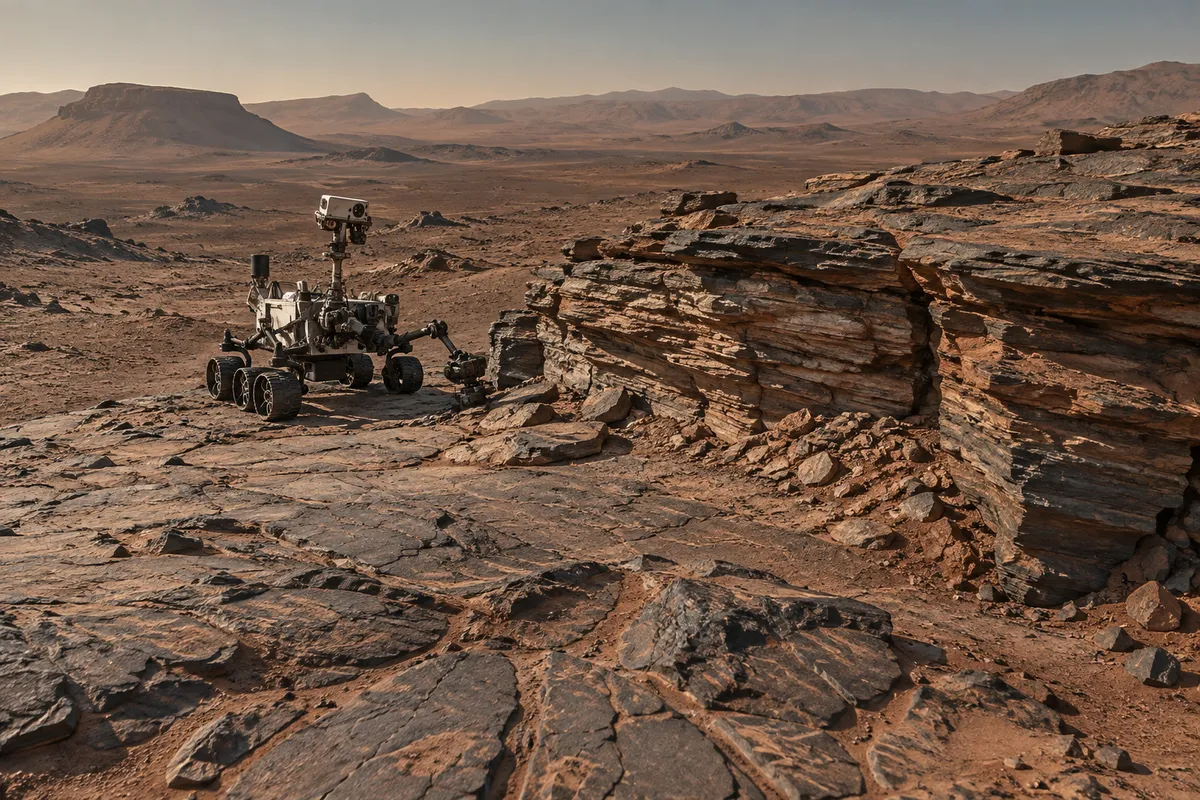
Scientists and ethicists are asking a question that sounds like science fiction but is edging toward engineering: who gets to decide whether Mars is transformed? By the end of this article, you'll know what could be lost if we rush, why researchers say the time to talk is before the tools exist, and what they want in place first.
The call comes in an opinion article reported by Phys. Its core warning is that transforming Mars into a more Earth-like world could irreversibly destroy scientific evidence about the planet's history and about the possibility of extraterrestrial life.
Mars is a library, and terraforming is a fire
The most useful way to understand the argument is to picture Mars as an archive. Per the Phys report, the scientists point to the planet's climate history, its geology, and the potential for past or present life as records that could be erased by large-scale modification.
Think about what terraforming means in practice: warming the planet and thickening its atmosphere so it behaves more like Earth. Those changes are the point of the project. They are also exactly the kind of changes that could alter or wipe out the surfaces and conditions that hold Mars's story.
The key word in the researchers' warning is irreversibly. You can pause a research program. You can't un-warm a planet and put the evidence back.
Why this is being discussed now
Terraforming has long lived in novels and movies. According to the coverage, it is shifting toward plausible engineering. Two things are driving that shift:
- Research on atmospheric warming that makes the idea of changing Mars's climate feel less abstract.
- Advances in heavy-lift rockets, which make settling Mars seem more realistic.
Private funding and rapid progress in space technology add another worry: they may outpace the ethical and scientific rules meant to guide them. That is the heart of the timing argument. Debate is cheapest before anyone has the ability to act.
The question nobody can yet answer: is there life?
Here is the surprising part. We don't know whether Mars has, or ever had, life. The researchers' concern is that terraforming could destroy evidence of it before we find out.
That makes the situation unusual. Most big projects start by asking whether they're possible. This one raises a prior question: should we finish looking before we start rebuilding? If microbial life, living or fossilized, exists there, a rapid environmental overhaul could make it impossible to ever confirm.
It also shapes the ethics. An answer of "yes, Mars had life" would change how the planet is viewed. Losing the chance to learn that answer is the kind of loss that can't be corrected later.
What the scientists are asking for
Per the report, the authors argue for three things before large-scale modification becomes feasible:
- Stronger planetary protection. Rules designed to keep other worlds scientifically intact need to be taken further as ambitions grow.
- Public scrutiny. Decisions about an entire planet shouldn't be made quietly or only by those building the rockets.
- International oversight. No single company or country, they argue, should be the one to decide Mars's future.
Notice what is not in that list: a ban. The argument, as reported, is about sequence and accountability, not about ruling out the idea forever.
Who speaks for Mars?
The headline question is deliberately uncomfortable. Mars has no residents to vote, but several groups have a stake:
- Scientists, who want to read the planet's record before it changes.
- Settlers and companies, who want a habitable destination.
- Everyone on Earth, since Mars is not owned by anyone.
The tension is sharpest around private companies. The coverage highlights the ethics of private firms reshaping an entire planet, and the concern that governance could lag behind funding. That's my reading of the stakes, not a claim from the report: when money and technology move faster than rules, the default decision-maker tends to be whoever arrives first.
Preservation versus settlement
It would be easy to cast this as scientists against explorers. The framing in the report is more specific: science before settlement. Studying Mars thoroughly first doesn't have to cancel human ambitions, but it changes the order of operations.
There is a practical logic to this. Every tool we have for reading planetary history works best on a planet that hasn't been rewritten. Once the climate is altered, some questions may simply stop having answers.
What you can take from this
Next time you see a headline about making Mars livable, ask two things: what would we learn first, and who would decide? The researchers' point is that those questions are far easier to answer now, while Mars is still an unread library, than after the first page has burned.