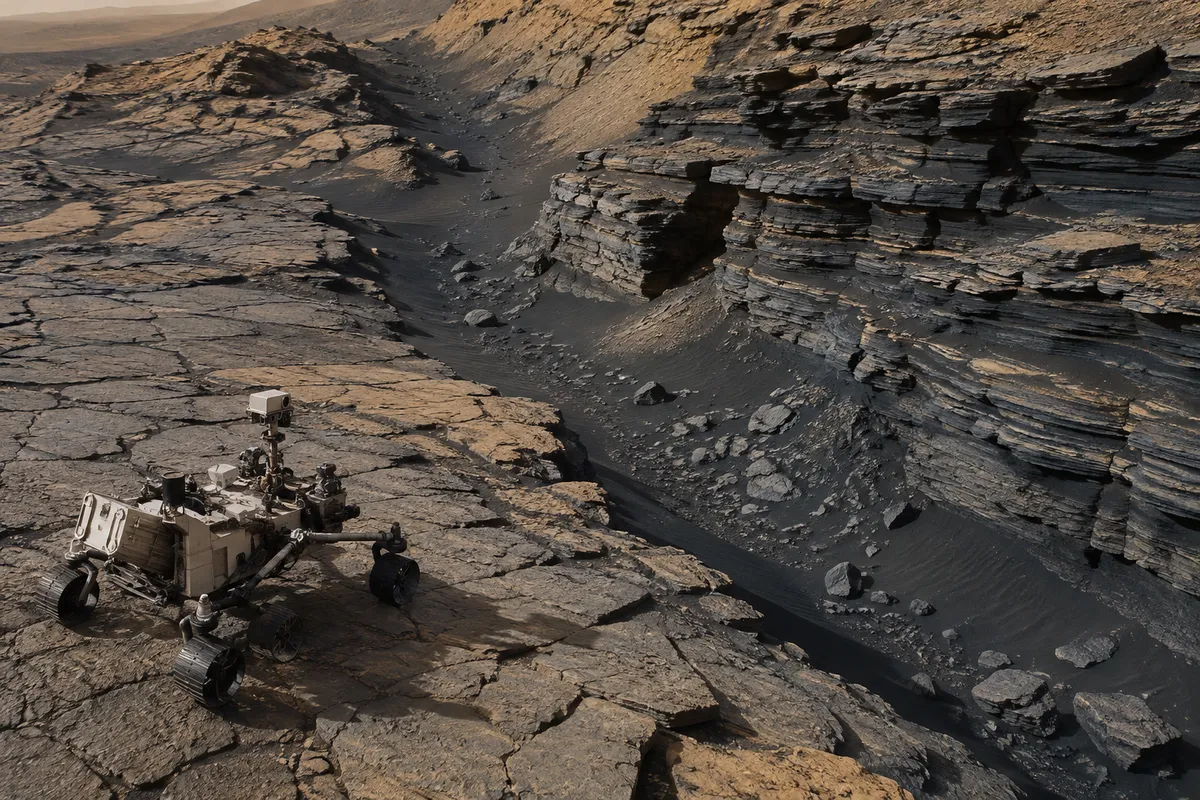
Imagine finding a 4.5-billion-year-old library and deciding to renovate it before anyone has read the books. That's the worry behind a new call from scientists and ethicists, reported by Phys: before anyone tries to make Mars more Earth-like, we should have a serious public debate about whether we should, and who gets to decide.
By the end of this article, you'll know what could be lost, why the timing matters, and the questions people are asking about governing another planet.
What scientists are warning about
According to Phys, the argument appears in an opinion article. Its core claim is that transforming Mars into a more Earth-like world could irreversibly destroy scientific evidence about the planet's history and about the possibility of extraterrestrial life.
The authors argue for stronger planetary protection, public scrutiny, and international oversight before large-scale modification becomes feasible. Note the word before. They aren't saying terraforming is happening tomorrow. They're saying the rules should exist before the capability does.
What Mars might be holding
Per the report, the concern covers three kinds of evidence:
- Climate history: how Mars's climate changed over time.
- Geology: the physical record written into the planet's surface.
- Possible life: signs of past or even present life.
Think of the planet as a record that only exists once. Warm it up, thicken its atmosphere, or otherwise reshape its conditions, and you may overwrite the very clues that would tell you how it got to be the way it is. Unlike a lab experiment, there's no rerun.
The life question is the sharpest one
If Mars ever hosted life, or still does, then changing the planet could destroy the evidence, or the organisms themselves, before we ever recognize them. That's why astrobiology is central to this debate. We haven't confirmed life anywhere beyond Earth. The argument is that not knowing is exactly the reason to be careful, since a mistake here can't be undone.
This also raises a question that's more philosophical than scientific. If a planet might have its own biology, does it deserve protection in its own right? The article's title puts it plainly: who speaks for Mars?
Why this is coming up now
Terraforming used to belong to science fiction. Phys reports that it's shifting toward plausible engineering, with research on atmospheric warming and advances in heavy-lift rockets making Mars settlement feel more realistic.
There's a second pressure too: private funding and rapid space-technology progress may outpace the ethical and scientific governance meant to guide them. In other words, the technology could move faster than the conversation. That gap is what the authors want to close.
Who gets to decide?
This may be the most useful question to carry away. Mars isn't owned by any one company or country in a way that makes it obvious who should make these calls. The scientists' answer, as summarized by Phys, is that decisions of this scale should involve:
- Stronger planetary protection, so exploration doesn't wreck what we're trying to study.
- Public scrutiny, so the choice isn't made quietly by a few players.
- International oversight, because the planet's fate isn't a single nation's business.
The report details on how such oversight would work aren't spelled out in the coverage, so it's fair to say the framework itself is still an open question. That's the point of the debate.
Science first, or settlement first?
The tension is easy to see. Settlement advocates see a second home for humanity. Preservation-minded scientists see a one-time chance to understand a neighboring world's history, and possibly the origins of life, before we alter it.
These goals aren't necessarily enemies, but they can conflict on timing. Studying Mars carefully takes time. Building a habitable Mars, if it ever becomes possible, would likely move on commercial and political timelines. The authors' push is to make sure science isn't an afterthought.
What you can take from this
You don't need to be an astrophysicist to weigh in on this kind of question. A few things worth holding onto:
- Irreversible choices deserve slower decisions. The case for debate rests on the fact that you can't un-terraform a planet and recover lost evidence.
- "Can we?" and "should we?" are separate questions. Engineering progress answers the first. Only public discussion can answer the second.
- Not knowing is a reason for caution. We haven't found life on Mars, but we also haven't ruled it out.
Mars has waited billions of years to be read. The most practical thing we can do is agree on the rules before anyone picks up a pen. When Mars comes up in the news, ask not only what's technically possible, but who is in the room deciding.