
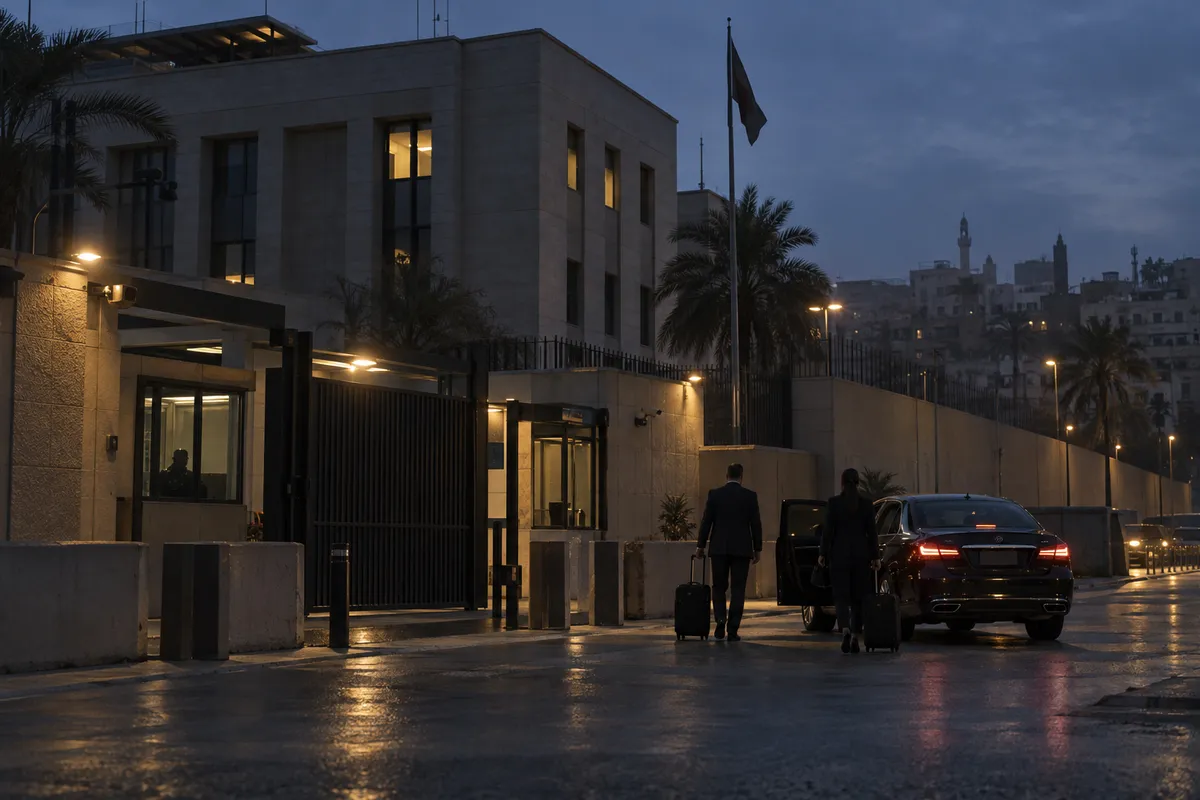
Iranian officials have told The New York Times that U.S. diplomats and government personnel could be targeted in any new war, according to a report by Ynetnews. By the end of this piece, you will understand why governments respond to a warning like this by quietly shrinking their embassies, and what that move does and does not tell you.
What was reported
Per Ynetnews' account of the NYT reporting, two Iranian officials, one of them from the Revolutionary Guard, described U.S. diplomats as "fair game." They reportedly cited the killing of Iranian leaders and their relatives in U.S. and Israeli strikes as justification for retaliation.
The report also says U.S. intelligence believes some assassination plots may be advanced, but that Tehran's actual reach remains uncertain. That last point matters. A stated intention and a proven capability are different things, and the reporting does not establish how far any plan has progressed.
The context, per the same coverage, is rising tension amid expectations of another possible U.S. or Israeli strike on Iran. Washington is already reducing diplomatic staffing across the Middle East.
Why a threat shrinks an embassy
An embassy is a fixed target. Its address is public, its staff follow routines, and its people live and travel within a known area. You cannot hide a building. You can only reduce how many people are exposed inside it.
That is the logic behind a staffing drawdown. Fewer people means fewer potential victims, a smaller security burden, and a simpler evacuation if things get worse. Think of it like boarding up part of a house before a storm: the house is still open, but less is at stake.
A drawdown is also a hedge against uncertainty. Intelligence that says plots are "advanced" but reach is "uncertain" is exactly the kind of mixed picture where caution is cheap compared with the alternative.
What "fair game" signals
The phrase suggests Iranian officials see retaliation as justified rather than something to deny. That is our reading, not a confirmed policy. It is notable because governments usually avoid openly acknowledging plans to target diplomats, who are traditionally protected under international norms.
Another plausible reading is deterrence by messaging: saying the quiet part out loud may be meant to make Washington think twice before striking. The reporting does not tell us which interpretation is right, and the officials' motives are not established.
Why the Revolutionary Guard keeps coming up
The Revolutionary Guard is one of the officials' affiliations in the report. Coverage of this kind often points to it because it is a military force with a role beyond Iran's borders, which is why intelligence agencies track it closely. The report detail here is limited: one of the two officials belonged to it, which adds weight to the claim but does not by itself prove operational plans.
How a single attack could widen a conflict
This is the part that makes embassy safety more than a staffing story. An attack on diplomats is different from an attack on soldiers. It can be read as an assault on a country itself, which tends to demand a response.
The chain is easy to picture, and it is analysis rather than prediction:
- An attack on American personnel occurs.
- Washington feels pressure to respond.
- The response is read by Tehran as new aggression.
- Each side's retaliation justifies the next.
The danger is miscalculation: each side acting on a guess about what the other will do. Uncertainty about Iran's reach makes guessing more likely, not less.
What you can take from it
When you see an embassy reduce staff, treat it as a precaution, not proof that an attack is coming. It signals that decision-makers see enough risk to act before the facts are clear.
And when you read a dramatic quote from an official, ask two questions: what is being claimed, and what has actually been shown? In this case, the threat is stated; the capability is still uncertain. Keeping those two apart is the simplest way to read a tense news cycle without being swept along by it.