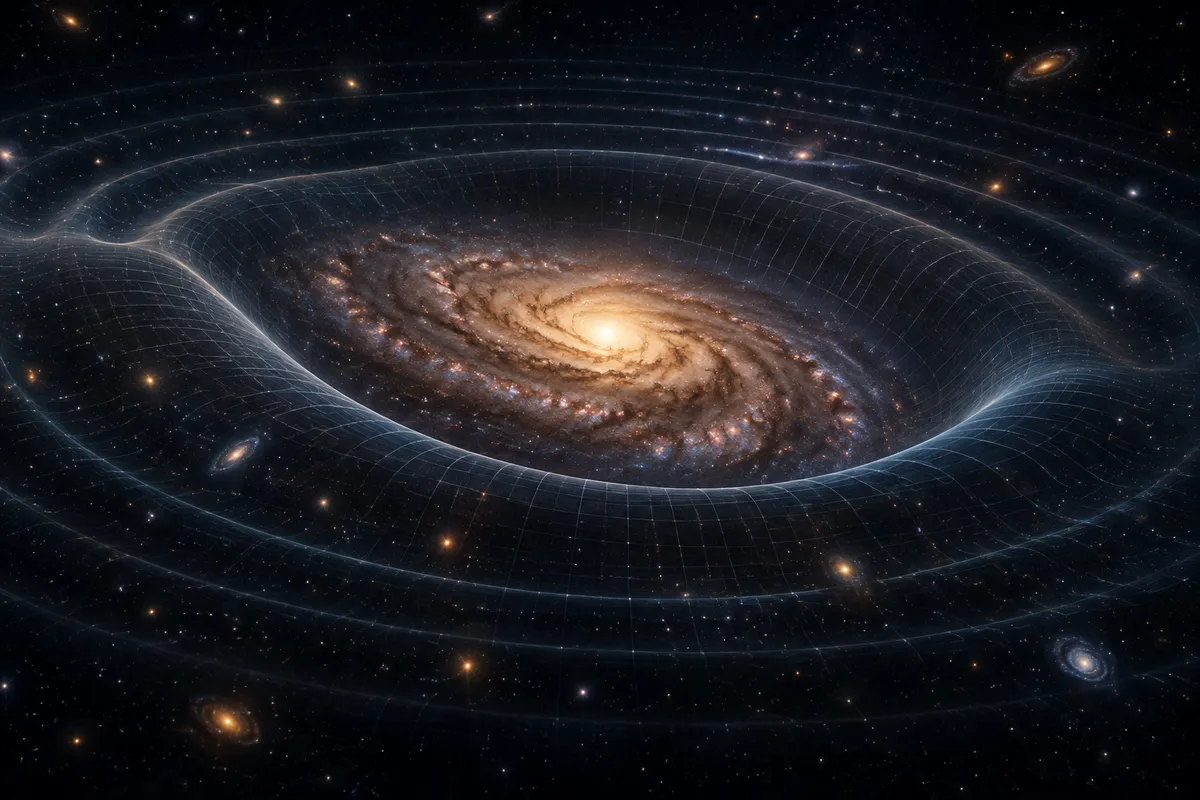
Physicists have a slightly unnerving worry: what if the universe's basic settings aren't the most stable ones available, and reality could shift to a different state? A new study, reported by Phys, offers a reassuring idea about why that hasn't happened. By the end of this article, you'll understand the worry, the proposed explanation, and why a concept from quantum computing sits at the center of it.
The worry: a universe that might not be at rock bottom
Picture a ball resting in a small dip on a hillside. It looks settled. But somewhere lower down there's a deeper valley. The ball is stable only as long as nothing pushes it over the rim.
Physicists call that kind of situation a "false vacuum." Per Phys, the concern is that fundamental fields in the universe, the Higgs field being a prominent example, might be sitting in such a state. If so, they could in theory shift into a lower-energy configuration. That would fundamentally alter reality.
The mechanism here is quantum tunneling. In quantum mechanics, a system doesn't always need enough energy to climb over a barrier. It can, with some probability, pass through it. So a field in a false vacuum could, in principle, tunnel into a lower-energy state.
The puzzle: why hasn't it happened?
The universe is very old, and yet it appears stable. If tunneling were a simple, unchecked process, you might expect it to have occurred by now. The new study, which Phys says involved a researcher in a College of Engineering and Computer Science, proposes an answer: quantum interactions in the early universe may have "locked" the fields into their existing energy states.
In other words, the universe may be trapped in its own comfort zone, and the study suggests why it can't easily leave.
The borrowed tool: ideas from quantum computing
The interesting twist is where the explanation comes from. According to Phys, the research applies principles from quantum information science, the field behind quantum computers.
Quantum computer engineers spend a lot of effort on a problem called decoherence. A quantum system behaves in delicate, "quantum" ways only while it stays isolated. When it interacts with its surroundings, those behaviors get disrupted. The system is effectively pinned into a definite state rather than free to explore possibilities.
That's a nuisance for building quantum computers. In a cosmic setting, it could be a protective feature.
How interaction can freeze a system in place
The report idea behind this kind of protection is related to the quantum Zeno effect. Roughly, a quantum system that is constantly being interacted with, or effectively "observed," struggles to change. Think of a pot that never boils because you keep checking it, except that "checking" here means any interaction with the environment, not a person watching.
I should be clear about the limits of what's been reported. The summary from Phys describes the finding as a proposal: interactions "may have" locked the fields in place. It doesn't present this as settled fact, and I can't tell you from the available reporting how the calculations work in detail. What the idea offers is a plausible physical reason the tunneling never got going.
What this means for the universe's long-term stability
The takeaway, as the study frames it, is that the universe's apparent stability may not be luck. It may be a consequence of how quantum interactions shaped the early cosmos.
That speaks to a genuine question about the ultimate fate of the universe. If fields are locked into their current states, the dramatic scenario of reality spontaneously changing becomes less of a looming threat. I'd stress that this is my reading of the proposal's implications, not a guarantee from the researchers.
Why this crossover is a big deal
Two very different areas of physics are meeting here. Quantum computing is about controlling tiny systems in a lab. Cosmology is about the largest and oldest system there is. That ideas built for the first can help address questions in the second suggests that the same quantum rules apply at every scale, and that practical engineering work can feed back into our understanding of the cosmos.
The simple version to remember
- A false vacuum is a state that looks stable but isn't the lowest-energy option.
- Quantum tunneling is how a system could, in theory, escape it.
- Interactions, the same kind that cause decoherence in quantum computers, may have pinned the early universe's fields in place.
The next time someone brings up the universe suddenly "resetting," you can explain that physicists have a candidate reason it hasn't: the cosmos may be held in place by the very quantum interactions that make quantum computers so hard to build.