
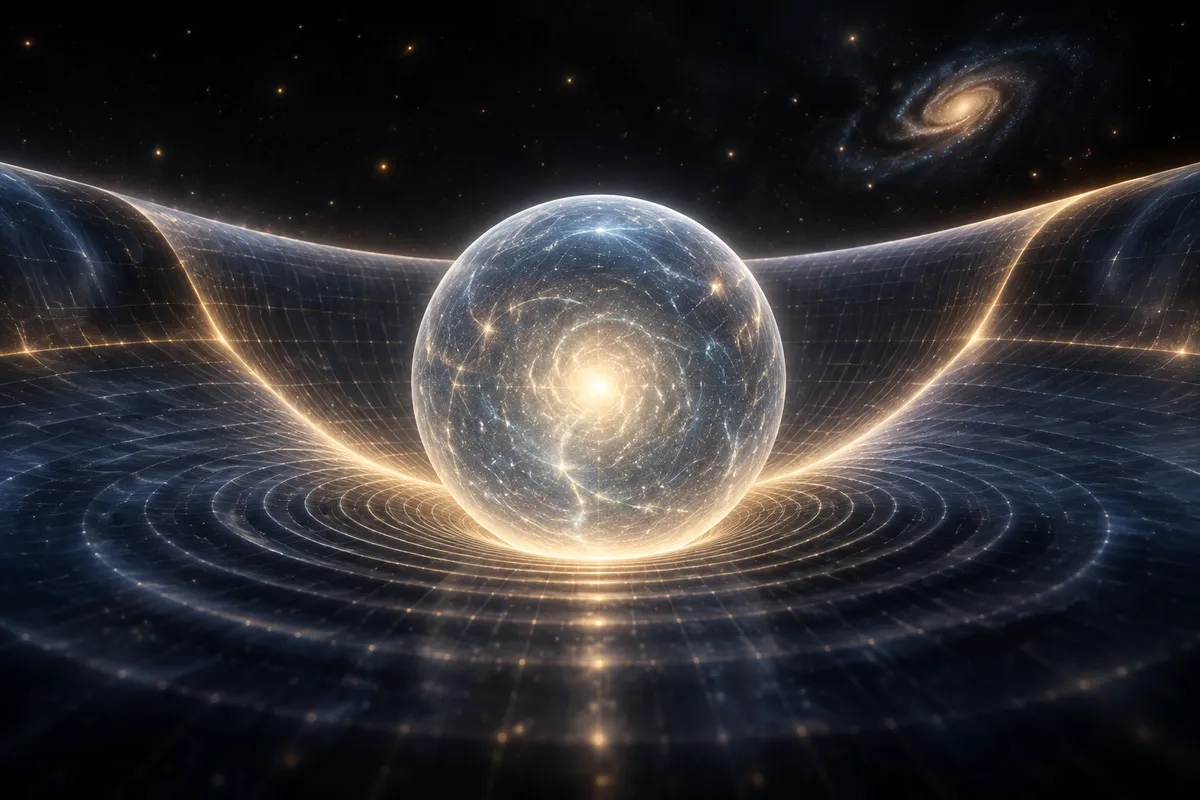
Physicists have a nagging worry: the universe might not be as stable as it looks. A new study, reported by Phys, proposes a reassuring answer. Quantum interactions in the early universe may have "locked" the fundamental fields into their current energy states, so they can't slip into lower-energy configurations. By the end of this article, you'll understand the worry, the proposed fix, and why an idea from quantum computing is part of the story.
The worry: a universe that might be in a "false vacuum"
Think of a ball resting in a small dip on a hillside. It looks settled. But if a deeper valley lies farther down, the ball is only temporarily stable. Give it enough of a push, or the right quantum luck, and it rolls away.
Physicists use the term "false vacuum" for this kind of situation. According to Phys's report, the concern is that the Higgs field, or other cosmic fields, could be sitting in such a state. If so, they could spontaneously shift to a lower-energy configuration, which would fundamentally alter reality.
That's the existential part. A change in a field's energy state isn't a minor tweak. It could change the basic properties of the universe.
The odd part: quantum tunneling
The ball in our hillside picture would need a shove to escape its dip. Quantum physics offers a different route. Quantum systems can "tunnel" from one state to another without climbing over the barrier in between. That's what makes the false vacuum scenario a theoretical risk rather than a purely classical one.
So the puzzle is this: if tunneling is possible, why hasn't it happened? The universe has been around a very long time, and it still appears stable.
The proposed answer: the early universe locked things in place
The new study, which includes a researcher from a College of Engineering and Computer Science, suggests that quantum interactions in the early universe may have locked the fields into their current energy states. In other words, the universe may be stuck in its own comfort zone, and these interactions explain why it can't seem to leave.
The key move is borrowing from quantum information science, the field behind quantum computing. That field has spent years studying how fragile quantum behavior is and what disrupts it.
Why a quantum computing idea fits
The Phys summary points to two related concepts from that world. I'll explain them in plain terms, and I'll flag where the details go beyond what the report states.
Decoherence
Quantum computers are famously finicky. A quantum system behaves in strange, flexible ways only while it stays isolated. When it interacts with its surroundings, those delicate quantum properties break down. Engineers call this decoherence, and they fight it constantly.
The study's angle, as described, is that this same kind of environmental interaction might protect the cosmos. If fields are constantly interacting, the delicate quantum behavior needed for a tunneling event may not be able to build up.
The quantum Zeno effect
The related idea is the quantum Zeno effect: a quantum system that is repeatedly "observed," or constantly interacting with its environment, can be frozen in place. The classic image is a watched pot that never boils. Here, the interactions don't need a person watching. Any interaction with the environment can do the job.
The report description of the study frames the early universe's interactions as doing something like this: holding the fields where they are rather than letting them drift to a lower-energy state. Whether the paper uses the Zeno effect in exactly this way is something I can't confirm from the summary, so check the original study for the specifics.
What this means for the fate of the universe
If the lockdown idea holds up, it addresses a real gap. Theories that allow a false vacuum predict a risk, yet we observe a stable universe. A mechanism that keeps the fields pinned in place would help reconcile the two.
It's also worth being clear about what this is. It's a proposal from a new study, not settled physics. Phys describes it as a suggestion, and other researchers will need to test and challenge it. Nothing in the report suggests any change is imminent. The point is that the stability we see may have a physical explanation, not just luck.
The bigger surprise: tools for computers solving cosmic mysteries
The most striking part of this story may be where the idea came from. Quantum computing was built to solve practical problems. Yet the concepts engineers developed to keep qubits stable may help explain why the universe has stayed stable since its earliest moments.
That's a pattern worth noticing. Ideas built for one purpose often turn out to describe something much larger.
The takeaway
Next time someone says the universe is "fragile," remember the other possibility: the same quantum interactions that make a quantum computer hard to build may be what keep the cosmos steady. If you want the full details, read the original study and Phys's coverage, and see how the authors make the case themselves.