
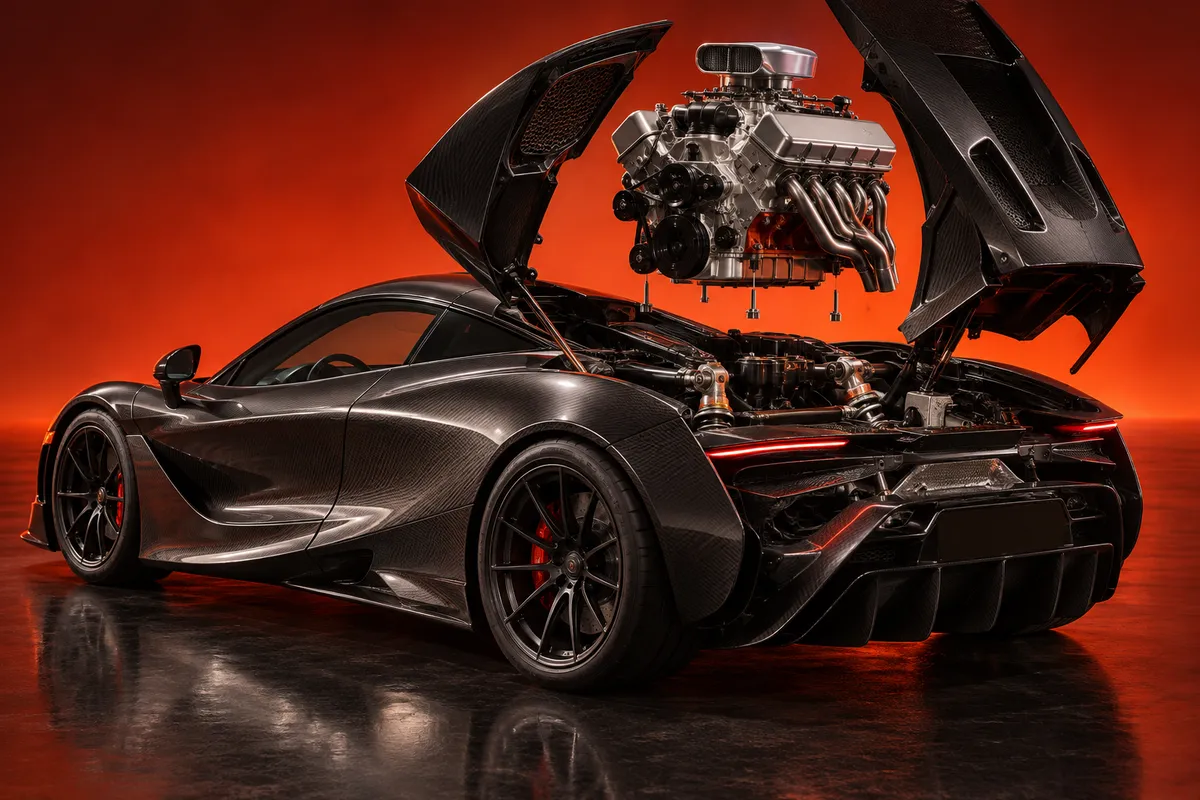
A British carbon-fiber supercar with an American big-block V8 shoved into it sounds like a joke. It isn't, really, and by the end of this article you'll know why the idea has a real racing pedigree behind it.
What the artist built
Per Autoevolution, Andreas Wennevold, the virtual artist behind the "wnvld" account on social media, has created a CGI concept that swaps the McLaren 720S's powertrain for Chevrolet's ZZ632 big-block V8. The engine is rated at 1,004 horsepower. The result is a digital "Big Block Supercar."
To be clear about what this is: a rendering. Nothing in the report suggests a physical car exists. It's a "what if," drawn with the polish of a factory photo shoot.
Why it isn't as wild as it sounds
The concept is framed as a modern homage to McLaren's Chevy-powered M8 race cars. That's the key to the whole thing. McLaren putting American V8 power in its machines isn't a random mashup invented for the internet. The company has done it before, in racing.
So the CGI build isn't asking "what if McLaren did something unthinkable?" It's asking "what if McLaren revisited something it already did?" That small shift turns a gimmick into a piece of heritage storytelling.
The culture clash is the appeal
The 720S is a study in precision: lightweight carbon construction, engineered down to the gram. A big-block V8 is the opposite temperament, built around displacement and brute force. Putting them together creates a tension people enjoy looking at.
The name ZZ632 hints at the scale of the engine. Chevrolet's ZZ632 is a crate engine, meaning it's sold as a complete unit for builders to install. That's part of why swap fantasies feel plausible: this isn't a one-off lab monster, it's a product.
Why a fantasy like this lands right now
Autoevolution's framing notes that McLaren is refreshing its brand and winding down the 750S era, leaning into its heritage. When a company starts looking backward, fans do too, and fan-made reinterpretations of past icons find an eager audience.
There's also a broader appetite for restomod and engine-swap fantasies that are impossible but plausible. Digital art lets someone test the idea with no budget, no engineering constraints, and no risk. It's a cheap way to ask, "how would this look?"
What CGI does for car culture
Renderings like this let enthusiasts debate ideas long before any metal is cut. A few things they do well:
- They test taste. A concept either looks right or it doesn't, and the comments section decides fast.
- They connect eras. Mixing a modern supercar with a vintage racing idea makes history feel current.
- They stay honest only if labeled. A render is a render. The fun depends on remembering it isn't a real car with real packaging, cooling, or weight figures.
That last point matters. Details like how a big-block would fit, how it would change the car's balance, or whether it would perform better are not covered in the report, so any claims about them would be guesswork.
The takeaway
When you see a wild engine-swap image, ask one question before you decide whether it's absurd: has anything like it happened before? Here, the answer is yes, in McLaren's own Chevy-powered M8 racers. Check the history first, then enjoy the fantasy for what it is.