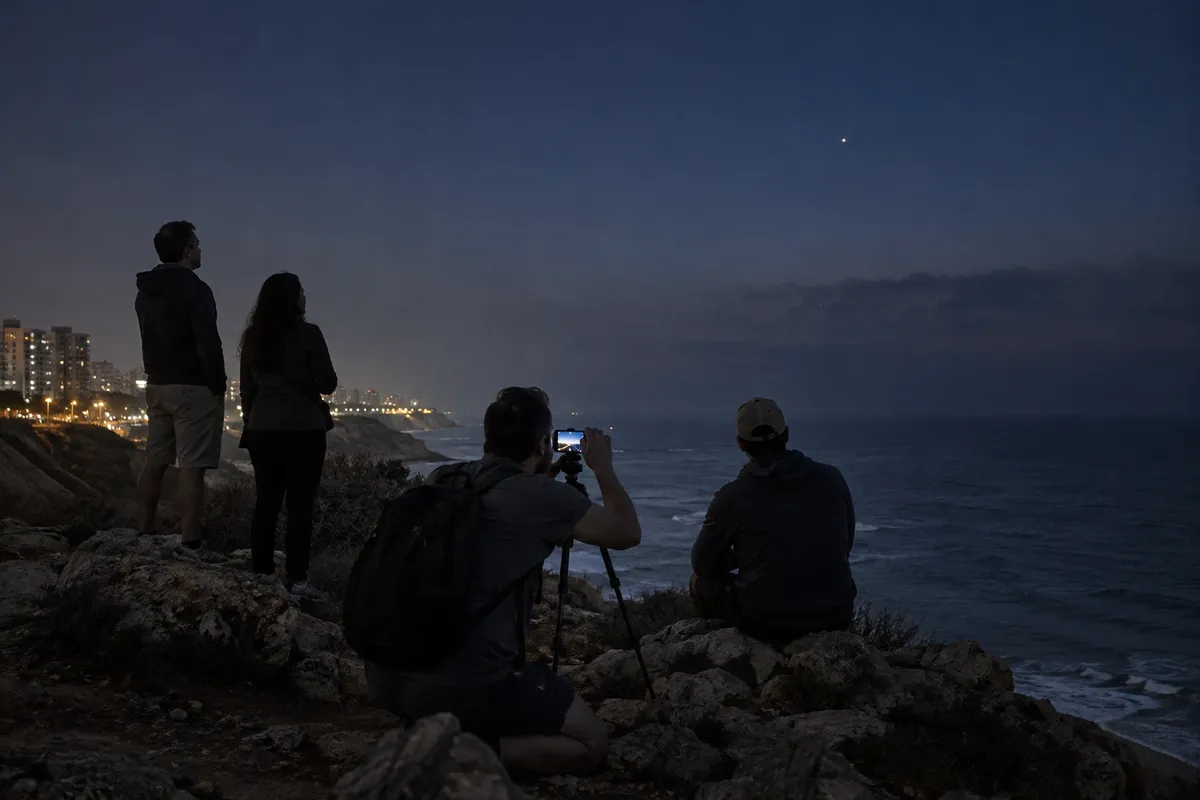
On a secluded cliff above the Mediterranean in Netanya, a group of UFO enthusiasts gathers after dark. Per Ynetnews, they come to watch for mysterious lights, share accounts of unexplained sightings, and try to contact extraterrestrial beings through meditation. The spot is known among them as "Alien Hill."
You don't need to believe in aliens to learn something from this scene. By the end of this article, you'll have a simple, skeptic-friendly way to think about any odd light you spot overhead, and a clearer sense of why people climb cliffs at night to look for them.
What happens on Alien Hill
According to Ynetnews, the routine is part sky-watching, part storytelling. People scan the dark horizon over the sea. They swap accounts of things they couldn't explain. Some also practice CE5 meditation, an attempt to make contact with extraterrestrials.
The report balances believers' dramatic accounts with more cautious voices, including the acknowledgment that some of what people see could simply be airplanes. That balance is the useful part, because it's exactly the question anyone faces when a light looks wrong.
A practical way to judge a mystery light
The source doesn't offer a checklist, so what follows is general common sense, not a claim from the report. Treat it as a starting point.
Start with the boring answer
The airplane explanation raised in the report is a good first guess. Aircraft carry bright lights and can look strange from certain angles, especially over open water where there's no landscape for scale. Ask the dullest question first: could this be a plane?
Watch it for longer
A light that seems baffling for ten seconds often looks ordinary after ten minutes. Note whether it moves steadily, blinks, or changes direction. Written notes beat memory.
Record details, not conclusions
Write down the time, where you stood, which way you faced, and what the sky looked like. "Steady white light moving left to right" is more useful than "a spaceship." Documenting sightings is part of what the Netanya group does, and the habit is worth borrowing.
Compare notes
Two people seeing the same thing from different spots can help rule things out. Sharing accounts, as the group does, works best when people compare facts before they compare theories.
Why the coast draws sky-watchers
This part is my own reading, not something from the report. A cliff over the sea offers a wide, dark horizon with few buildings in the way. Open water also makes distance hard to judge, so lights can seem closer, faster, or stranger than they are. It's easy to see why places like this collect legends.
CE5 meditation, without the hype
CE5 is the practice Ynetnews describes: meditating in an attempt to contact extraterrestrial beings. Nothing in the report presents it as proven, and it's best understood as a ritual of attention and hope. For participants, it adds a quiet, contemplative layer to what could otherwise be a purely technical hobby.
Why this is in the news again
UFOs and UAPs, the newer term for unidentified aerial phenomena, are back in Israeli headlines. Recent reports of aerial objects near the Lebanese border raised security concerns, per the coverage. That's a different matter from hobbyists on a hill: official concern about unidentified objects is about safety, not aliens.
The real draw: mystery, together
The most interesting question isn't whether aliens are real. It's why people gather in dark, natural places to look up together. The story touches on a mix of spirituality, nature, technology, and citizen investigation. Looking at an unexplained sky is an old human habit, and it feels different in company.
That's the smart takeaway. Curiosity and skepticism aren't opposites. The best sky-watchers hold both: they stay open to wonder and still say "maybe it's a plane."
Next time a strange light catches your eye, don't rush to an answer. Watch it, write it down, and rule out the ordinary first. Then enjoy not knowing for a minute.