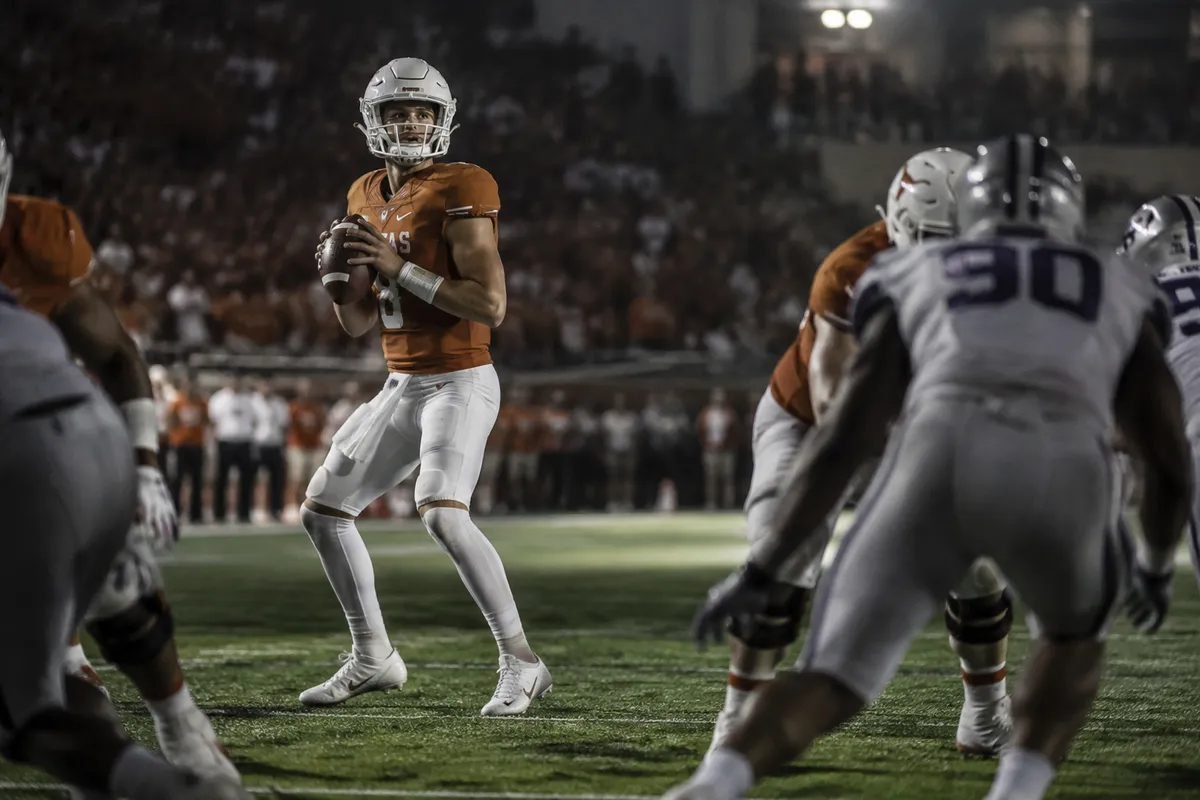
Texas beat No. 7 Ole Miss 34-27, but the score hides how close it got. The Longhorns led 24-3 and still needed the final play to secure the win, according to Fox News. Here is a simple way to judge a game like this: separate what a team did once from what it keeps doing. By the end, you'll know how to tell a fluke from a pattern.
What happened in Austin
Per Fox News, Texas looked dominant early, with Arch Manning showing flashes of what made him one of the sport's most talked-about players. Then the second half arrived, and the 24-3 cushion shrank until the game came down to the last snap. Ole Miss, quarterbacked by Trinidad Chambliss, pushed Texas to the edge.
Fox News also reported that Texas flipped a switch in the fourth quarter to hold on. The outlet framed the game as another second-half meltdown, with the Longhorns described as talented but dangerously inconsistent, especially on offense.
One bad half is a fluke. Repeated bad halves are a pattern.
This is the part that makes you sound smart at the next watch party. A single collapse can come from a few unlucky bounces, a tired defense, or a hot opponent. Statisticians call this noise. When the same thing keeps happening, it starts to look like signal, something built into how the team plays.
Fox News describes this game as "another" second-half meltdown, which points to repetition rather than a one-off. That is the outlet's framing, and it's a reasonable lens. Here's a quick test you can apply to any team:
- Count the repeats. Does the same problem show up in several games, not just one?
- Check the cause. Is it random (turnovers, a freak play) or structural (play-calling, adjustments, execution)?
- Look at the opponent. Did a strong team exploit a weakness, or did the team beat itself?
By that test, Texas's issue looks more structural than random, though only the people inside the program know the true cause.
Why leads feel safe but aren't
A 21-point lead feels like a finished game. It isn't, for a few plain reasons.
Opponents get more aggressive
A team that's trailing big has nothing to lose. It takes risks, speeds up, and goes for plays it would skip in a close game. A leading team often does the opposite and plays tighter.
Offenses can go conservative
When a team protects a lead, it tends to run more and take fewer shots. That can burn clock, but it can also stall drives and hand the ball back. This is a general dynamic, not a claim about what Texas specifically did, since the reporting doesn't give play-by-play detail.
Good opponents adjust at halftime
Ole Miss was ranked No. 7, a strong opponent. Strong teams use the break to fix what isn't working. A lead built against an unadjusted opponent is the most fragile kind.
The Arch Manning question
Fox News points to flashes from Manning, and that word matters. Flashes are moments of brilliance, not sustained excellence. The open question around him, per the piece, is whether he's progressing or simply becoming more volatile.
That's a fair thing to wonder, and it's hard to answer from one game. A young quarterback can look sharp for a half and shaky for the next. What would settle it is trend data: does the gap between his best and worst stretches narrow over a season? One game can't tell you. Watching the next few can.
What the win does and doesn't tell you
Here is the surprising takeaway. A win can hide a team's weaknesses better than a loss can. Texas got the result, which feels like proof of strength. But the way it got there, a 21-point lead nearly gone, is evidence of a problem the scoreboard doesn't show.
Fox News notes that Ole Miss exposed Texas even in defeat. That's a useful reminder that the final score is only one measurement. Margin, how it changed over time, and who controlled each half all tell you more about what comes next.
What's next for the Longhorns
The schedule gets no easier. Per Fox News, Texas faces Missouri and LSU in a tougher SEC stretch, and questions about Manning, head coach Steve Sarkisian, and whether Texas is truly elite are growing louder. The piece argues Sarkisian's offense still hasn't solved consistency.
If the pattern is real, tougher opponents will test it. If Texas plays a full four quarters against Missouri and LSU, the Ole Miss game will look like a blip. If the lead slips again, it will look like the rule.
How to read the next Texas game
Skip the final score for a moment and check three things: the halftime margin, the second-half margin, and whether the offense kept moving the ball after the break. Do that for each of the next two games. If the second-half drop shows up again, you're no longer looking at a fluke. You're looking at a pattern.