
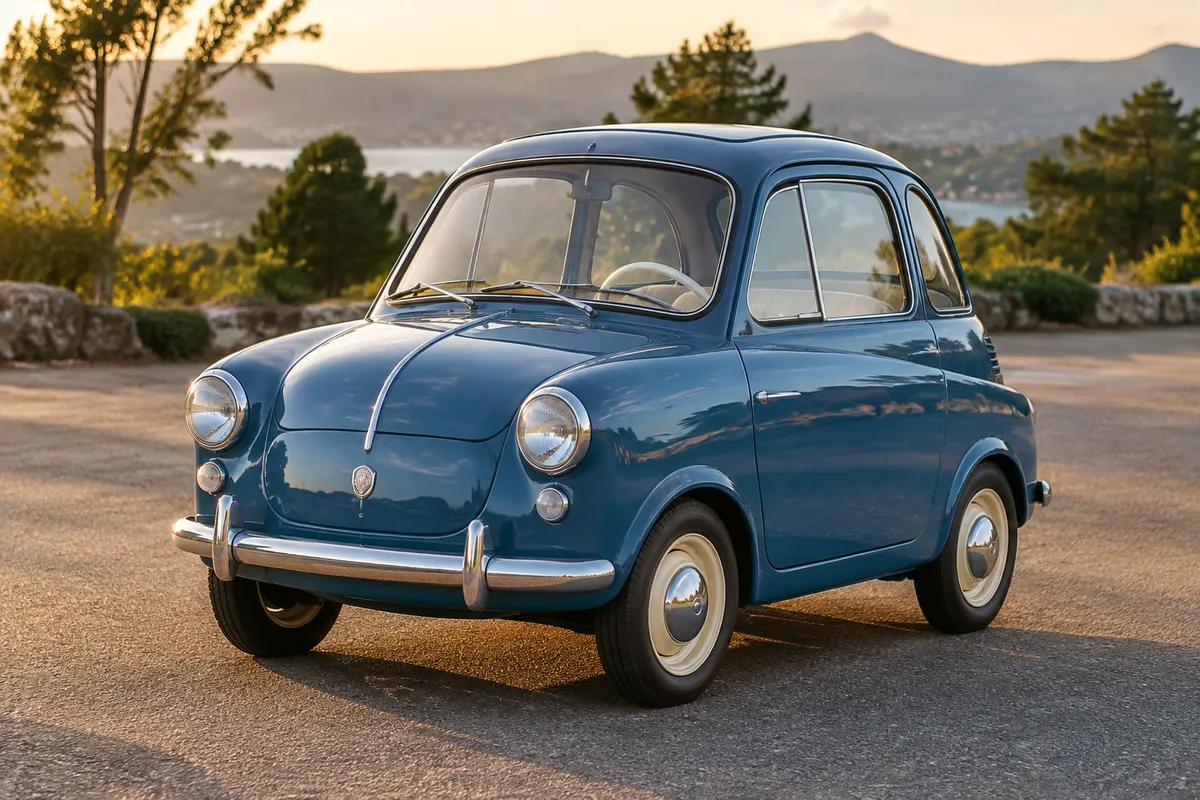
A Vespa with four wheels may sound like a naming mix-up, but Piaggio really did make a car called the Vespa 400. A restored 1959 example, finished in Narvik Blue, is now for sale in Florida for $37,500, according to Autoevolution. Its unusual badge and small size make it an appealing curiosity. The price raises a more practical question: what makes a tiny, 14-horsepower car valuable to a collector?
The answer is not simply how much car you get for your money. The Vespa 400 is a rare piece of automotive history, and its worth depends on what a buyer wants from a classic: everyday usefulness, rarity, design, or the pleasure of owning something few people expect to see.
The Vespa 400 was a car, not a scooter
The familiar Vespa name is associated with scooters, but Autoevolution’s report spotlights a different branch of the brand’s history: Piaggio’s microcar. The 1959 Vespa 400 was built as a small car, not as a scooter with a body added around it.
That distinction is part of the car’s charm. The badge sets up one expectation, then the vehicle itself overturns it. For someone drawn to automotive history, that surprise is more than a novelty; it gives the car a story that is easy to remember and share.
Autoevolution places the Vespa 400 in the postwar microcar era and describes its production run as short. The broad idea behind a microcar is right there in the name: a car designed around a compact scale. But the available details don’t give a complete specification sheet or exact production total, so it would be misleading to fill in those blanks or make precise comparisons with other small cars.
What the $37,500 listing does—and doesn’t—tell you
The Florida listing gives a few concrete clues: this is a 1959 example, it has been restored, it wears Narvik Blue, and the asking price is $37,500. Autoevolution also identifies the car’s engine output as 14 horsepower. Those details help explain why the Vespa 400 attracts attention, but they don’t establish that the asking price is fair—or that the car will sell for that amount.
An asking price is a seller’s starting point, not proof of market value. And “restored” is useful information, but it doesn’t tell you exactly what work was done, when it was completed, or how the car performs now. The listing’s color is a visual detail, not a substitute for information about its condition or history.
So is $37,500 too much for a 14-horsepower microcar? The number alone can’t answer that. A buyer shopping for modern transportation would likely judge it by very different priorities than someone looking for a rare collectible. If the goal is practical driving, a tiny engine output may be a drawback. If the goal is a distinctive piece of Vespa and microcar history, rarity and character may matter more than power.
That doesn’t mean any unusual old car is automatically worth its asking price. It means the price needs to be judged against the specific car and the buyer’s reasons for wanting it—not against a simple horsepower-per-dollar calculation.
What a buyer should ask before getting attached
The information in Autoevolution’s report is enough to understand the car’s appeal, but not enough to make a purchase decision. Anyone considering this example would need to ask the seller for details that aren’t provided in the report. For instance:
- What work did the restoration include, and when was it completed?
- Are there records documenting the car’s history and restoration?
- What is its current mechanical condition?
- Can the buyer inspect it in person or arrange an independent inspection?
- Is the $37,500 price negotiable?
These aren’t claims about the Vespa 400 for sale; they’re the questions that remain open when a listing offers a short description rather than a full account of the car. Answers would help a prospective buyer decide whether the price reflects a well-documented classic or mostly its novelty.
The same approach works for any rare collectible: separate what is known about the object from what you hope is true about it. A striking color and an unusual badge make a good first impression. Documentation and a close look at the car help turn that impression into a more grounded judgment.
The appeal is its story as much as its size
The Vespa 400’s most obvious hook is that it exists at all. Piaggio produced a microcar under a name many people connect with scooters, and this restored 1959 example brings that forgotten history into view. The short production run, according to Autoevolution, adds to its rarity; the Florida asking price shows that this particular car is being presented as a serious collectible, not merely an oddity.
But the listing doesn’t settle the bigger question of what the car is worth. That depends on evidence the report doesn’t provide, including the restoration details and the condition a buyer finds on inspection. Until then, $37,500 is a price to investigate rather than a verdict on the entire microcar market.
If you’re drawn to the Vespa 400, start with the story, then check the paperwork and condition before deciding what that story is worth to you.