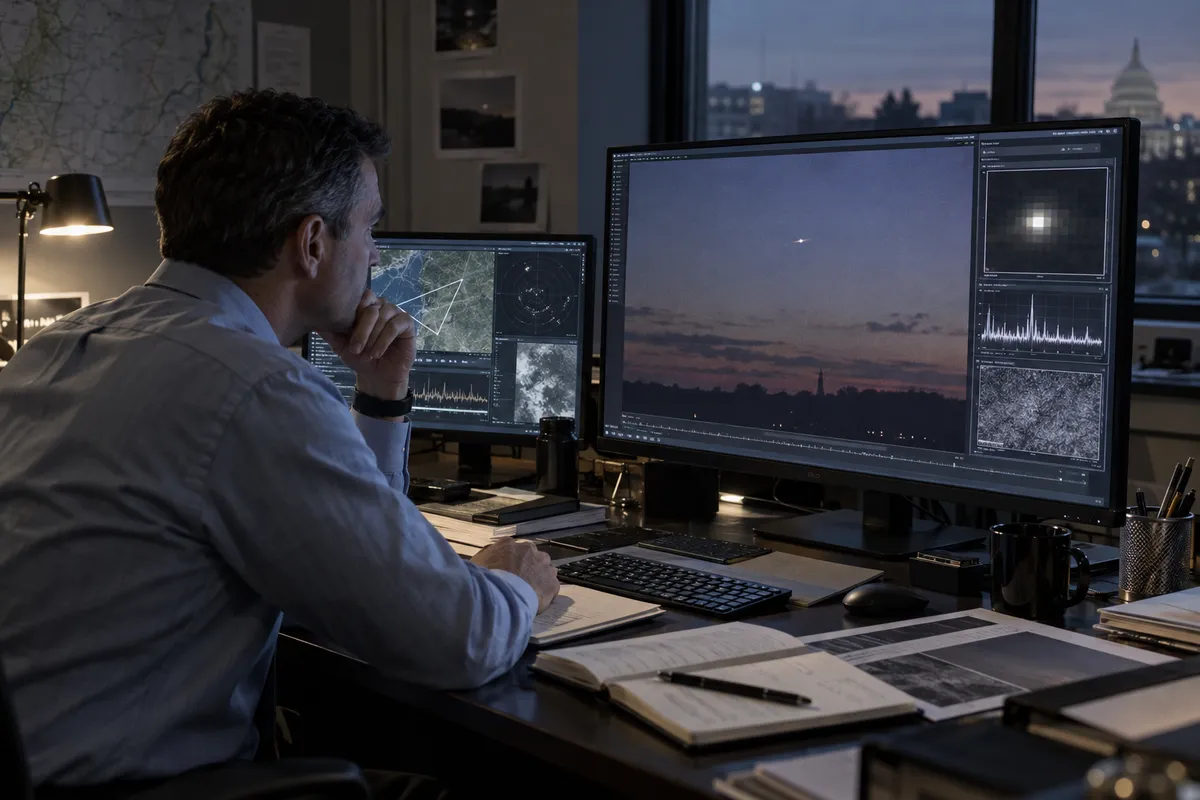
A Pentagon UFO investigator has revealed his identity and described what he learned from examining unexplained aerial phenomena, including one video he says he can't forget, according to an exclusive from People.com. The details of that interview aren't something we can fully reproduce here, so we won't guess at what the video shows or what he concluded about it.
What we can do is use the moment to answer a question the story raises: how do you tell a credible UFO report from hype? By the end, you'll have a simple, five-part checklist you can use the next time a viral clip or dramatic claim lands in your feed.
Why this story matters: UFOs moved from fringe to official
Per the reporting, public interest in UFOs, now often called UAPs (unidentified anomalous phenomena or unidentified aerial phenomena), has surged as government officials, whistleblowers, and military witnesses push the topic into mainstream conversation. An investigator putting a name and face to the work is part of that shift.
That shift matters because the subject has changed shape. A topic once dominated by campfire stories now involves government inquiry, and that brings a different standard: not "is it spooky?" but "can it be checked?"
"Unexplained" does not mean "alien"
This is the single most useful idea in the whole topic, and it's the one that makes you hard to fool.
"Unidentified" describes what we know about the object. It says nothing about what the object is. A blurry dot that nobody can name is simply a blurry dot nobody can name. Filling that gap with extraterrestrials is a leap, not a finding.
That's also why one video can stay with an investigator for years without proving anything. Being unable to forget something is a statement about the person, and about how puzzling the footage is. It isn't evidence about where the object came from. We don't know what the investigator concluded about his video, so treat any confident claim about it, from anyone, with caution.
A five-part checklist for judging UAP evidence
These are general reasoning tools, not the investigator's own method, which we haven't been given. They work on almost any claim.
1. Is there more than one source?
A single camera can glitch, smear, or catch a lens flare. A report gets stronger when separate instruments or witnesses capture the same thing. Think of a visual sighting backed by radar, or two people at different angles describing the same event.
2. Do the people reporting have training and a reason to be careful?
Military witnesses are used to identifying aircraft, which makes their accounts more useful than a casual glance. It doesn't make them infallible. Trained observers can still be fooled by distance, lighting, or unusual conditions.
3. Is the original data available?
A clip reposted fifty times, cropped and captioned, is a rumor with a video attached. Look for the original file, who recorded it, when, and with what equipment. If nobody can say, you have a story, not evidence.
4. Have ordinary explanations been ruled out?
Credible inquiry starts boring. Birds, balloons, drones, planes, reflections, and sensor artifacts come first. Only if they fail does the case get interesting. Be wary of anyone who skips this step and jumps to the exotic.
5. Is the claim sized to the evidence?
"We can't identify this object" is a modest claim a video can support. "This is a craft from another world" is enormous and needs enormous support. When the conclusion is much bigger than the data, hype is doing the work.
Secrecy makes everything harder to judge
The People piece frames UFO research as a mix of government secrecy, eyewitness intrigue, and the search for credible answers. Those pull in different directions. Secrecy can protect sensitive military technology, and it can also leave the public unable to verify anything, which is fertile ground for speculation.
The practical takeaway: when information is withheld, the absence of an explanation isn't a hidden explanation. Silence tells you the data isn't public. It doesn't tell you what the data says.
What to do the next time a UFO story goes viral
Run the five questions. Who recorded it, and can you find the original? Did anything else confirm it? Were mundane causes checked? Does the conclusion match the evidence?
If the answers are thin, you can stay curious without being convinced. That's not cynicism. It's exactly the posture a serious investigator needs, and it lets you enjoy the mystery of an unexplained video without mistaking it for an answer.
So the next time a clip stops you cold, ask the investigator's question first: not "what is it?" but "what would it take to find out?"